Showing posts with label Louisiana. Show all posts

Wednesday, March 11, 2026

Pope Update

In the 9-16 matchup at the SEC Tournament in Nashville, the Cats beat LSU 87 to 82.  Brandon Garrison was the MVP of the game, behind 17 points -- including two three-pointers.  Kam Williams came back, and scored 3 points in 17 minutes.  The Cats move to 20-12 on the year, and they advance to play Number-8 seed Mizzou tomorrow afternoon.  UK remains at Number 27 on Ken Pom, with a ranking of 233 for luck.

My guess is that today's game will end the Matt McMahon era at LSU.  In four seasons, he has gone 17-55 in the SEC.  Interestingly, his team's rankings on Ken Pom have improved every year -- from 151 to 95 to 88 to 62.  But I will be surprised if he gets another year at LSU.  After all, they have standards.  It will be a bad day for UK if LSU brings in a big-name coach.

Tuesday, August 19, 2025

Thirty-Two Franchises: New Orleans Saints

Have participated in the NFL since the 1967 season.

All-Time Record:  417-480-5 (.465)

The all-time series between the Saints and the Falcons is tied at 56 wins each.

Super Bowl Record:  1-0 (XLIV) (2009)

Top Passer:  Drew Brees (68,010 yds)
Top Rusher:  Alvin Kamara (6,779 yds)
Top Receiver:  Marques Colston (9,759 yds)
Top Coach:  Sean Payton (152 wins)

Top All-Time Player Based on Approximate Value:  Drew Brees (AV of 228)

Drew Brees's career AV (including his time at San Diego) is 277.  That's the second highest AV of all time.

Brees's record as QB of the Saints was 142-86 (.622).  Without Brees at QB, the Saints have a record of 275-394-5 (.411).

Tuesday, May 28, 2024

Southeastern Conference (1932-2024)

In November 1932, Franklin Roosevelt was elected President for the first time, thus launching a new era in American politics.  One month later, in December 1932, thirteen members of the old Southern Conference left to form a new conference:  the Southeastern Conference.  Those members were:

University of Alabama
Auburn University
University of Florida
University of Georgia
Georgia Institute of Technology 
University of Kentucky
Louisiana State University
University of Mississippi
Mississippi State University
University of the South (Sewanee)
University of Tennessee
Tulane University
Vanderbilt University

The founding of the SEC formalized the tripartite division of Big-Time College Sports in the South.  In the East, the schools that would form the Atlantic Coast Conference in 1953, were heavily influenced by the notion that Southerners should be led by an elite caste of high-minded people.  (There is a reason that the University of Virginia is known as the Cavaliers.)  From an intellectual perspective, this viewpoint was well-represented at the University of North Carolina, which has long stood for a form of genteel Southern liberalism.  In the Southwest, the tremendous resources of Texas led to a culture of extremes -- you could choose the elitism of the University of Texas, the devout social conservatism of Baylor, or a variety of options between them that continue to the present day.

But the people who lived between the Appalachian Mountains in the East and the Sabine River in the West had their own views.  Politically, this is country that largely belonged to Andrew Jackson -- and as a result, it has always trusted the views of average people more than it trusts the views of experts.  Because average people tend to love tradition, this region has often been very traditional.  But this region has never been very good at accepting authority, and thus is generally uncomfortable with the type of overt elitism you might find in Charlottesville, Chapel Hill, or Austin.  In 1933, this region was starting to see some glimmers of hope after many years of difficulty, and they knew that their people were very excited about college sports.  So striking out on their own made a huge amount of sense.

In fact, the creation of the SEC was a watershed in the history of the region.  For the next 90 years, millions of people who lived in these states identified with the SEC, and marked their seasons by its calendar.  Sewanee couldn't afford to stay in the conference after a few years, and so dropped out.  But the other 12 original members stuck together until 1964, and by that point the SEC had become a major force in Southern life.  SEC fans didn't just root for their teams -- they rooted for their conference (and their vision of the South that it represented) against the teams from the ACC and the Southwest Conference.

By the mid-1960's, Atlanta and New Orleans were entering a new era of their own, and so Georgia Tech and Tulane left the SEC.  But the original ten members stuck together until 1991 -- going through integration, negotiating early TV deals, and building the legend.  The SEC never lost its popularity, but in the 1980's there was a marked contrast between the success of the region -- which was enjoying significant economic and population growth -- and the fact that SEC teams usually couldn't compete with Florida State and Miami in football, or with North Carolina and Duke in basketball.

In retrospect, the SEC of the 1980's was a gold mine waiting to be discovered, and Roy Kramer was the person who figured it out.  Kramer became the sixth Commissioner of the SEC on January 10, 1990, and within seven months the SEC had announced plans to add Arkansas and South Carolina.  For the first time, the SEC had reached into the territories traditionally controlled by the Southwest Conference and the ACC.  Even more importantly, the SEC could take advantage of a loophole that allowed any conference with 12 teams to play an extra football game as a conference championship.

From 1991 to 2012, the SEC went through a golden era.  After years of being a scrappy underdog, the SEC finally had the type of monetary and media support that its fans wanted.  The schools took that support and used it to build much stronger programs -- not only in football (which the SEC began to dominate) but in almost every other sport.

By 2012, the SEC had become so strong that both Texas A & M and Missouri were eager to join.  Now at 14 teams -- including one team in the heart of Texas and another from the old Big Eight -- the SEC had truly become a Super Conference.  But still, the SEC's slogan -- "It Just Means More" -- underscored the popular traditionalism that had been key to its success all along.

Over time, however, the Conference that had started as an underdog had become so powerful that its success disrupted the rest of college sports.  This fact created a whole new challenge for the SEC and its region.  For years, the SEC looked out for the interests of its fans, regardless of what that meant for the rest of the country.  But as the 2020's began, that approach became more and more difficult to maintain.  After all, it doesn't do you any good to win the National Championship unless there are other teams across the country that can give you a game.  And as the NCAA faced more and more legal challenges, and the rest of college sports became unstable, the SEC faced hard choices about how to proceed.

A few years ago, the SEC announced its decision:  the league would expand again to include the University of Texas and the University of Oklahoma.  For most of the last 90 years, these were two of the football programs that the SEC had measured itself against -- now, they were acknowledging that the SEC had won, and they would rather switch than fight.  It was, and is, a tremendous victory for the SEC and its fans.  But it was also a loss.  No longer will the SEC belong to our region.  Going forward, it will be a national, and perhaps an international brand -- just like Coca-Cola.

For almost 90 years, SEC fans were proud to be scrappy underdogs going up against the bigger and richer schools in the rest of the country.  Those days have come to an end, and those of us who love this region can be proud of the success that the SEC attained.  But greater power means greater responsibility.  Going forward, fans in the old SEC heartland can't just think about what's best for their school or their region -- they have to consider the whole field of college sports.

Maybe they'll do great.  I certainly hope so.  Contrary to Lord Acton, power does not always corrupt.  Sometimes, it causes people to take more responsibility.  For a long time, folks in the SEC looked out for themselves regardless of what anyone else thought.  They can't do that any more, and maybe they will be wiser and more generous as a result.  But whatever they do, the SEC will never be the same.  Watching the SEC become respectable is like imagining Burt Reynolds's Bandit settling down with a country club membership and a big house in Mountain Brook.  

Becoming respectable always carries a price.  At the end of Huckleberry Finn, Huck says:  "I reckon I got to light out for the Territory ahead of the rest, because Aunt Sally she's going to adopt me and sivilize me, and I can't stand it.  I been there before."  The SEC has always been more Tom Sawyer (let's win within the rules) than Huck Finn (let's do what's right, regardless of the rules), so I'm not surprised to see the SEC strive for respectability.  But I will miss being underdogs.

Sunday, March 31, 2024

Iowa v. Louisiana St.

I'm already excited about this game for tomorrow night.  Last year, LSU beat Iowa for the National Championship:  102 to 85.  This year, for reasons I don't understand, they were placed in the same region, so only one of these teams can reach the Final Four.

Saturday, March 30, 2024

Regional Finals

Four tickets to the Final Four going out this weekend.  Here's what it looks like:

Saturday, March 30:
EAST (in Boston):  (1) Connecticut (34-3) v. (10) Illinois (29-8)
WEST (in Los Angeles):  (19) Alabama (24-11) v. Clemson (24-11)

Sunday, March 31:
MIDWEST (in Detroit):  (3) Purdue (32-4) v. (6) Tennessee (27-8)
SOUTH (in Dallas):  (13) Duke (27-8) v. N. Carolina St. (25-14)

Almost every year, we get at least one team in the Final Four that has not been there in at least 20 years.  This year, Alabama, Tennessee, and Clemson have never been to the Final Four, and Purdue hasn't been there since 1980, so at least two teams in the Final Four will meet this criterion.

In the Regional Semi-Finals, Alabama's victory over North Carolina was the only game in which the western-most team won the game.  In the other seven Regional Semi-Finals, the eastern-most team won.  Illinois is now the western-most team left in the field.

Spare a thought for the Houston Cougars, who lost their All-American guard Jamal Shead 13 minutes into their game with Duke.  Houston ended up losing to Duke by 54 to 51, and I am certain that the Cougars would have won if Shead had remained healthy.

This will be the third meeting between Duke and N. Carolina St. this season, and all three meetings will take place in March.  On March 4, Duke went to Raleigh and thumped the Wolfpack, 79 to 64.  On March 14, in the quarterfinals of the ACC Tournament (in Washington, DC), N. Carolina St. upset Duke 74 to 69.  And tomorrow they will play the rubber match.

Here are Ken Pom's predictions this weekend:

Connecticut 82, Illinois 76
Alabama 83, Clemson 81
Purdue 76, Tennessee 73
Duke 78, N. Carolina St. 69

Meanwhile, over on the women's side, two of the Regional Finals are set:

Sunday, March 31:
ALBANY 1:  (1) S. Carolina (35-0) v. (12) Oregon St. (27-7)
PORTLAND 4:  (4) Texas (33-4) v. (11) N. Carolina St. (30-6)

Today we have the following Regional Semi-Finals:

ALBANY 2:
(2) Iowa (31-4) v. (17) Colorado (24-9)
(6) U.C.L.A. (27-6) v. (8) Louisiana St. (30-5)

PORTLAND 3:
(3) U.S.C. (28-5) v. (19) Baylor (26-7)
(10) Connecticut (31-5) v. Duke (22-11)

To me, the U.C.L.A. / L.S.U. game feels like the first really critical game in this tournament.

Monday, February 12, 2024

NFL23 Update: Hail to the Chiefs (Again)!

Congratulations to the Kansas City Chiefs! When I searched "Kansas City Chiefs" on Google a second ago, fireworks flew across the screen of my laptop.

And deservedly so! For my money, not I of the previous LVII Super Bowls was any more entertaining than last night's event featuring the Patrick Mahomes, Andy Reid, Travis Kelce, Harrison Butker, Chris Jones and the rest of the victor Chiefs; the worthy San Francisco 49ers; Taylor Swift and (hopefully) her future in-laws; Jim Nantz and Tony Romo; Andra Day, Post Malone and Reba McEntire; Dan Marino; Usher and Alicia Keys, and the rest. Starting at about 5 Central, I watched with my family virtually every second of CBS's remaining five hours of TV coverage from Las Vegas, and, my gosh, I felt so thankful to have gotten to experience the thing.

Furthermore, the Chiefs have now won two Super Bowls in a row, played in four since 2019 (winning three) and now are now 4-2 in all-time Super Bowl appearances. All time, that's the sixth-most Super Bowl appearances and fifth-most victories (along with the Green Bay Packers and New York Giants) for Kansas City, which also won more AFL championships (three) than any other team. What a franchise!

Did you know that the Chiefs' defense from 1966 through 1971 was apparently nicknamed "The Redwood Forest?" I did not. In fact, I don't think I exactly knew that the Chiefs' offense from 2018 through 2021 was apparently nicknamed "The Legion of Doom." I remember hearing Nantz and others say "The Legion of Doom" when I happened to be watching football games off mute during that time period, but I guess I always figured they were just making something up out of thin air to promote some comic-book movie that was out at the time and never paid much attention. Anyway, I learned both of these notes this morning from the Chiefs' Wikipedia page, which I intend to read over the next several days as I think back over my favorite memories from my very fun Sunday night.

Of course, at my typical HP pace, that will likely take me right through to kickoff of the Miami Dolphins' victory in Super Bowl LIX (Feb. 9, 2025, in New Orleans). Hail to the Chiefs, and comments flow!

Monday, September 12, 2022

My 10 Favorite Songs of the Last Seven Days

Car Wheels on a Gravel Road came out in 1998, and I bought it and loved it then, but it took about two years for me to really start receiving the healing that God was delivering through Lucinda Williams and her record. The perfectest of the perfect songs on it is this one, which is written in exactly the pace and manner by which I process anything hard (no matter how hard I work to go more quickly or head on at the task):

  1. "2 Kool 2 Be 4-gotten," Lucinda Williams
  2. Rocketman movements 1 and 2 of four, Marching Maroons during 2022 Maroon Classic
  3. “Crackers," Barbara Mandrell
  4. "Get a Witness," Commodores
  5. "Are You Sure Hank Done It This Way?" Waylon Jennings live on Soundstage 1975
  6. "I Was Country When Country Wasn’t Cool," Barbara Mandrell
  7. "That’s What You Get For Loving Me," Waylon Jennings
  8. "A Woman’s Kind of Man," Susan Raye
  9. "Soul Train ’75," Soul Train Gang
  10. “Hurricane," Bob Dylan live on PBS 1975

Wednesday, March 9, 2022

KHSFB98 Update

I love driving, and I love AM radio:

Nov. 20, 1998

Enjoyed a good bit of success following various high-school football playoffs on the car radio Friday night.

At 870 AM, I picked up a terrific show out of Louisiana. The format was similar to the NFL Gameday show One-on-One Sports puts together. This station had reporters at 12 games around Louisiana, and the studio hosts went rapid-fire game to game to game with updates.

The most interesting reports were coming in from a lopsided game that was being played, I believe, in Baton Rouge: Jolanga at West St. John’s. (Of course, all of these spellings are my best guesses based on my interpretation of the pronunciations; in fact, there are probably any number of errors here, but, Kornheiserstyle, the gist is on the mark.) The final update, at about 11:30 p.m. Eastern, had West St. John’s up, 22-9, in the third quarter. It was running so late because of multiple play stoppages: twice for passing trains, the noise of which apparently drowned out any play-calling the coaches or players were doing; twice for fights, and four times in the third quarter alone because of power outages which darkened the stadium. According to the last report, the opposing coaches had agreed that if the lights shut down again, both teams would load up on school buses and resume the game that night at East St. John’s High School “across the river.” Imagine that scene.

During breaks in this show, I picked up a similar program out of Raleigh, N.C., as well as Iowa City North vs. Des Moines Dowling out of Iowa.

About 30 miles from the state line, at about 9:30 p.m., I picked up the fuzzy call of the only Kentucky game I’d hear all evening: Sheldon Clark at Belfry, for a Class 3A regional championship.

According to the visiting radio crew from Inez, Sheldon Clark came into the game with a short football history of little note. This team had gone deeper into the 3A playoffs than any Sheldon Clark team ever had, but even that—with a 6-4 regular-season record—had been something of a disappointment until the postseason. One of the losses had come in the second-to-last week, decisively, against Belfry.

And yet Sheldon Clark held an 8-0 lead when, with 1:42 to play Friday, Belfry’s junior quarterback Wright, who completed 19 of 30 passes for about 250 yards, threw a touchdown pass (and then a two-point pass) to tie the game. Sheldon Clark’s coach, Jim Matney, elected to run out the clock when his team took over at its own 30 or so.

Sheldon Clark won the coin toss and elected to play defense in the opening possession of overtime. Wright completed a touchdown pass on first down, and Belfry kicked the extra point for a 15-8 advantage. As the Belfry fans’ cheered, it was announced in the stadium that Fort Thomas Highlands, the state’s top-ranked 3A team, had won its regional and would visit this winner in next week’s state semifinal.

On Sheldon Clark’s first down, a back named Moe Stradlin ran nine yards. On second, he plunged in for a touchdown to make it 15-14. Here roughly is the call of the two-point attempt by Jack Ward, a graduate of the old Inez High School, one of two Martin County high schools consolidated to form Sheldon Clark:

“The handoff is to Stradlin. … He’s in trouble. He’s not going to … YES! HE STRETCHES! YES! YES! YES!”

In the post-game show, Sheldon Clark’s coach, Matney, explained that “almost 22 years ago to the day” his high-school team had lost to Belfry, on this same field, for a chance to play in the state championship. Back then, Matney said, the high schools in Martin County were too small to field football teams, and he had moved in with a family in the next county so he would have an opportunity to play. (“They were poor and black, and I was poor and white. So we were the same.”)

“This win tonight is for all of the Sheldon Clark boys who built the foundation for this team and for all of the Martin County boys who never had a chance to play football,” said Matney, hoarse from the game and the on-field celebration immediately following it. “We’ve got so many people out of work, so many people having hard times in Martin County. Well, tonight, back home in Martin County, you hold your heads up high. Tonight, we’re the regional champions.”

Monday, November 18, 2019

Kentucky falls to 9th in the AP Poll

Kentucky paid for its loss to Evansville by dropping from 1st to 9th in the AP Poll.  (Ken Pomeroy has them at number 5.)

The last time UK was ranked number 9, they lost to Seton Hall in overtime on December 8, 2018.  That was a very painful game, and we will hope for better outcomes tonight.

Between December 2001 and January 2005, what I think of as the Chuck Hayes era, the Cats played 17 games when they were ranked at number 9 in the AP poll -- and they won every one of them.  That is actually a great summary of the Chuck Hayes era -- those teams were hard-working over-achievers that were always on the verge of breaking into the Final Four, even though they never actually did so.

Kentucky was ranked 9th in the AP poll when they won the 1958 Championship, which gives you an idea of what a big upset that was.

In my lifetime, Kentucky's finest moment as the number-9 team came on March 1, 1981, when the ninth-ranked Cats beat the second-ranked LSU Tigers 73 to 71 to prevent LSU from going 18-0 in the SEC.  That was truly a great moment in UK basketball.  In all my years as a Kentucky fan, I can think of no other game where the fans in Rupp Arena were so emotional.

Tuesday, January 16, 2018

Super Bowl VI

I'm pretty sure Super Bowl VI--on Sunday, Jan. 16, 1972--was the first featured on TIME's cover, and there's starting to be quite a bit of mirth-making in the culture around the priorities-out-of-balance spectacle of the game specifically and football generally.


This all reminds me of the handwringing among my ilk (and me, to some extent) in the 1980s about whether R.E.M., U2 or Natalie Merchant had "sold out."


I ultimately sided with the sellers back then, too. Those ads are from the pull-out Super Bowl advertising supplement published in the Jan. 10, 1972, Sports Illustrated, and so is this beautiful thing:


Speaking of commercialism, out-of-whack priorities out and spectacles, I am thrilled to announce that 1972 me--I'm still not certain whether he is an adult or child or what his story is exactly--did receive NFL Strategy at Christmas71! I plan to be getting out that game and my football-card Cowboys and Dolphins to play with during Super Bowl VI.


I am rooting for Miami in today's game, but most of the (so-called) "experts" appear to be picking Dallas.


There has been so much great stuff work put out on today's game by the reporters, editors, photographers, illustrators, agate typists and other artists at America's great newspapers. I appreciate all of them and their work, and I want to give a special shout-out for the fine treatment provided by the Toledo (Ohio) Blade.


The Apache Belles obviously put in their work, too, and thank you to those folks, too (spoiler alert, resultwise, in the following video).


OK, it's almost time for the 1:50 p.m. Central kickoff ...


Thank you to NFL, TV and Internet for making this full-game video available, and thank you, HP, for giving me a framework for getting to have so much fun!

Saturday, February 21, 2015

Oh, Kentucky (1969)

Herb Hays goes big in taking over a Hoptown furniture store. This ad occupied the whole back page of the Feb. 18, 1969, Kentucky New Era.


The New Owner's Plan apparently worked.
 
Here's more from the Feb. 8-22, 1969, editions of Hopkinsville's Kentucky New Era:


Three national stories that consistently made the front of the Hoptown paper during this era that I either didn't know much about at all or didn't realize were such a big deal were the saga of the USS Pueblo, the rash of plane hijacking and the Clay Shaw conspiracy trial around President Kennedy's assassination.


Good jobs news ...


Happy birthday, KFC!


Turning to sports ...


Raymond Burse is now the Kentucky State University president ...


From the routes desk ...


Saturday, February 14, 2015

Louisiana St. 69 - 71 Kentucky (No. 2,164)

Down through the years, every school in the SEC has developed its own theory of how to deal with Kentucky's basketball program.  Some of them (like Georgia and Auburn) take the position that they just don't care that much about basketball, anyway (unless they have a good team).  Alabama, true to its football heritage, generally relies on a rugged defense.  Florida has a genius coach.  Vandy relies on Memorial Gym.  Tennessee, as we will see next Tuesday, has its own conception of how to compete with the Cats.

But LSU, to its credit, rarely goes in for any sort of gimmick.  The Tigers have their own basketball history -- they've been to the Final Four three times that I can remember -- and they play in a state that produces a lot of great basketball talent.  So LSU, more than almost any other team in the Conference, is willing to just lace 'em up and go head-to-head with UK.

Down through the years, LSU's approach has resulted in a some unbelievably dramatic basketball.  Consider some of the games I've seen between these two, and you'll agree that this is one of the most underrated rivalries in college basketball:

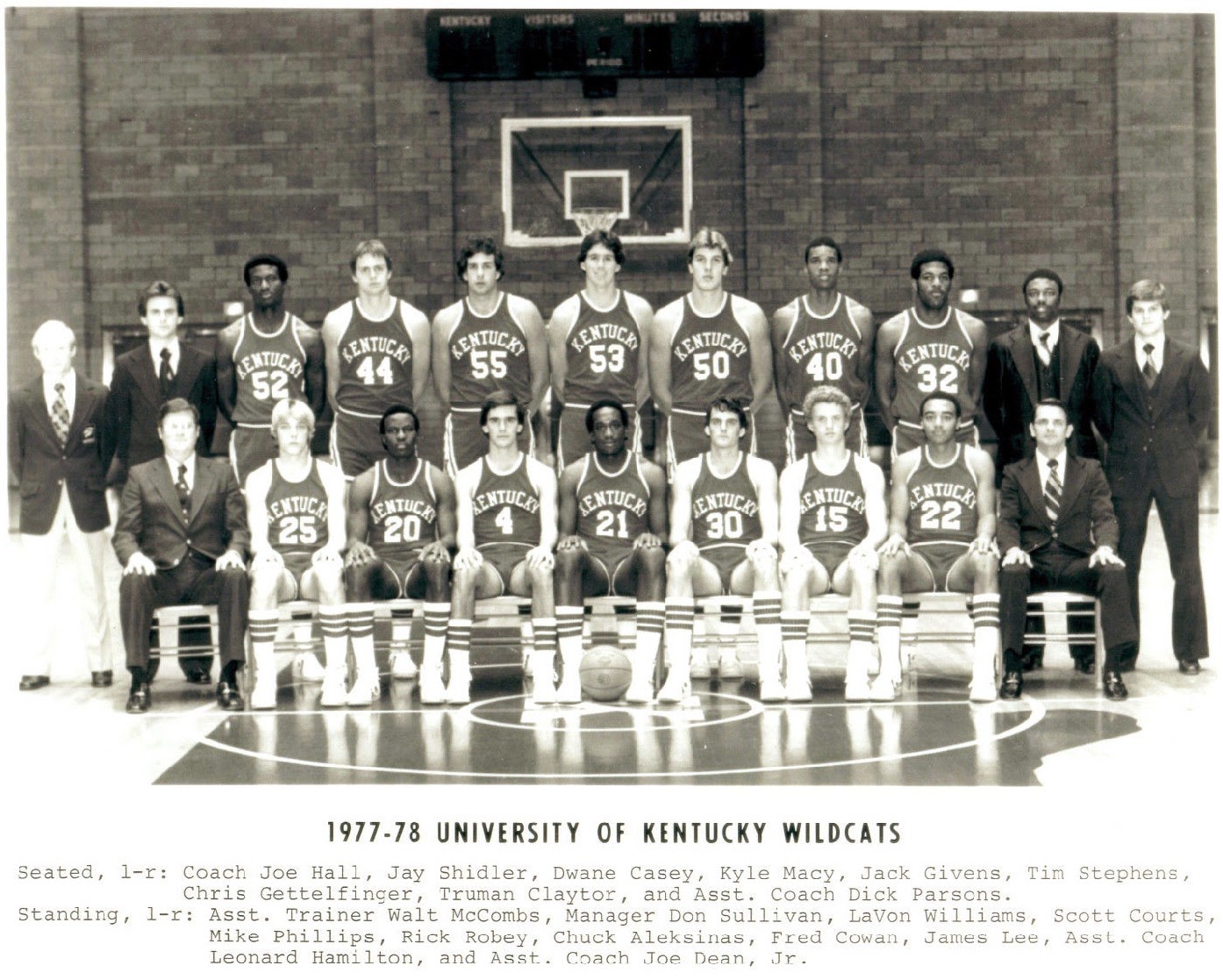
1.  In 1978, UK was on its way to a National Championship -- but the Cats lost 95-94 in overtime at Baton Rouge.

2.  In the last game of the 1980 regular season, Kyle Macy's last-second jump shot beat LSU 76-74 and gave the Cats the SEC crown.

3.  In the last game of the 1981 regular season, UK beat number-2 LSU at Rupp Arena by the score of 73-71, thus preventing the Tigers from becoming the first team ever to go 18-0 in SEC play.

4.  In the 1986 season, UK beat LSU three times -- 54-52 at Baton Rouge, 68-57 at UK, and 61-58 in the SEC Tournament.  But in the Elite Eight, LSU (a number 11 seed!) beat top seed UK 59-57, thus preventing the Cats from meeting Louisville in the Final Four.  At the time, LSU was the lowest seeded team ever to make the Final Four.  (This was the last game Kenny Walker ever played for UK, and to this day it bothers me more than any other game I've ever seen Kentucky lose.)

5.  In 1990, UK was not allowed to be on TV, and was playing a team of previously little-known scrubs in Rick Pitino's first season.  But the Cats stunned an LSU team that featured Shaquille O'Neal and Chris Jackson, beating them 100-95 before a rapturous crowd at Rupp.

6.  In 1994, UK trailed LSU 68-37 in the second half of a game at Baton Rouge, but came back to win 99-95 in one of the greatest games I've ever seen.  (LSU had two players -- Ronnie Henderson and Clarence Ceasar -- who scored over 30 points in this game).

7.  In 1996, UK went to Baton Rouge and played the best game I've ever seen from a Kentucky team -- they scored 86 points in the first half on their way to a 129-97 victory.

In 1997, Pitino's Cats drilled LSU 84-48 in the last of the 51 games that the Cats played against LSU Coach Dale Brown.  (Brown went 18-33 against the Big Blue).  The rivalry faded somewhat after that.  Under divisional play, UK only played LSU once a year, and the coaches who replaced Brown at LSU weren't able to tap into that same mixture of hatred and frenzy that had given so much spark to the UK/LSU games.  For younger fans, the LSU game became just another night in the long SEC schedule.

But divisional play is over now, meaning that the Cats now go to Baton Rouge two out of every three years.  And the current LSU coach, Johnny Jones, has the Tigers playing a fast-paced athletic style that plays to the school's historic strengths.  Last year, the Cats and Tigers played three times, and each game was very different.  LSU won 87-82 at Baton Rouge, then UK squeaked out a 77-76 over time win at Rupp, and then the Cats hammered LSU 85-67 in the quarter-finals of the SEC Tournament -- a dominant win that foreshadowed UK's great run through the NCAA's.

Since that big win in the SEC Tournament, the Cats have lost only twice -- to Florida in the final of the SEC Tournament and to UConn in the final of the NCAA Tournament.  Meanwhile, LSU has put itself very much on the NCAA bubble -- the Tigers were 17-6 overall and 6-4 in SEC play going into Tuesday night's game.  A win over the Big Blue would put LSU a long way toward the Big Dance, although ruining UK's undefeated season would probably mean even more to the typical LSU fan.  So LSU's basketball team enjoyed its first sellout crowd in nine years, as everyone came out to see if the Tigers could pull off the upset.  Les Miles was there.  Anthony Davis was there -- and what a thrill it was to see him again.  And, of course, Dick Vitale was there.  Press reports indicated that LSU had encouraged employers to let their folks leave early for the game -- which started at 6 P.M. Central Time -- and they must have listened, because the Pete Maravich Athletic Center was roaring at tip-off.

LSU traditionally eschews high-falutin' strategies -- the spirit of LSU basketball, at its best, is all about going for broke -- so I wasn't surprised when the Tigers were up 10-2 after only 3 minutes.  I have seen UK teams that would have struggled to overcome such a start, especially in front of such a manic crowd.  But this UK team has a streak of ruthlessness, and the Cats were no doubt happy to finally face an opponent that was determined to play them straight up.  Plus the Cats had Trey Lyles back in the lineup.  Soon UK and LSU were rolling up and down the Court in some of the most exciting action I've seen all year.  It was like watching two prize fighters throw haymakers at each other.  The Cats led 38-34 at the half, and then started the second half on a 20-11 run that featured some of the best basketball I've seen from UK all year.  Karl-Anthony Towns and Willie Cauley-Stein were simply killing LSU on the inside, and when Andrew Harrison hit a three-pointer to put UK up 58-45 with 12:46 left, even my pessimistic soul -- which is still haunted by the ghost of Rudy Macklin -- started to feel good about our chances.

In fact, the game would have been a blowout except for the fact that LSU kept making all sorts of difficult shots.  Keith Hornsby -- who is the son of Grammy Award winner Bruce Hornsby -- was firing off shots from all over the floor, while Jarell Martin (who finished with 21 points and 11 rebounds) and Jordan Mickey (16 points and 7 rebounds) were playing as well as anyone has all year against UK's front line.  Still, three guys shouldn't be enough to beat UK -- even in Baton Rouge, and the Cats appeared to have things in hand.

Still, LSU kept scoring, and UK's lead was down to 60-52 with about 10 and a half minutes to go.  At this point, I thought, Coach Calipari was trying to slow down the game.  I think Calipari wants the undefeated season much, much more than he has been willing to admit publicly, and I have noticed that he is coaching very hard to win every game.  UK is contesting almost every three-point shot, and I think part of this has to do with the fact that Calipari doesn't want to lose to one of those 12 of 21 nights from behind the arc that can happen in college basketball.  UK has also been taking the air out of the ball in late-game situations.  I'm sure that Calipari -- like me -- knew that this particular game was a major threat to the undefeated season, and he had to be extremely focused on the importance of milking this lead for the rest of the way.

At least, I assume something like that was going on, because Calipari suddenly went absolutely nuts.  With UK up 60-52, Towns headed toward the basket for what looked to be UK's 89th dunk of the game.  But he missed.  It didn't seem like that big a deal -- the ball rolled out to WCS, who tipped it in.  However, after his miss, Towns did a pull-up on the rim, and that's a technical foul in college basketball.  Cauley-Stein's tip in didn't count.  LSU got two shots and the ball.

For all my usual pessmism, I still wasn't that worried.  But Calipari was as upset as I have ever seen him -- he pulled Towns (who had been magnificent throughout) and berated him on the sidelines.  Calipari was still mad after the game, and every one of his post-game comments started with criticism of Towns's play.  I would like to know more about whether he was only angry with Towns's lack of discipline -- how much effort, for example, do the coaches put into warning people against pulling up on the rim -- or the extent to which he had a feeling (of the sort common to sports obsessives) that this particular stupid play had a cosmic significance, because it would cost UK the chance at an undefeated season.

If Calipari did have such a feeling, he was right.  With Towns (who had been UK's best player) on the sidelines, with UK's three-point shooters having a bad night (the Cats went 2-12 from three-point range), and with Calipari raging on the sidelines, the ever-eccentric Tigers suddenly looked like the best team I've seen all year.  They scored 14 points in a row to take a 64-60 lead into the media timeout with 7:42 left.  Towns was back in the game by this point, but Calipari had steadfastly refused to call time -- forcing the Cats to try to figure out what was happening on their own -- and the Cats had not been able to stop the bleeding.

UK had the ball out of the media timeout, and Hornsby immediately stole a pass from Cauley-Stein and zipped in for a layup to make the score 66-60 with 7:29 left.  Now the huge LSU crowd was going bonkers (I can only imagine what Vitale was saying), and UK was in big trouble.  And now, finally, with his team up against the wall.  Calipari called time.

When the Cats came back on the floor, it was clear that they were not going to let the game continue at the manic pace of the first 33 minutes.  The Cats were going to do what they usually do when it gets close late -- patiently work the ball inside on offense and go for a shutout on defense.  At first, it didn't look like this was going to succeed -- UK held the ball for 30 seconds without getting far.  Finally, Towns took a long jumper from the top of the key.  It went in -- UK's first points in four and one-half minutes of game time -- and the spell was broken.  The Cats were back in the game.

There was a lot of complaining from UK fans after the game about the Cats' defense, which looked somewhat shaky on this road trip.  But suddenly the Tigers were finding it very difficult to score, and UK slowly cut into LSU's lead.  With 2:43 left, a pair of free throws by Andrew Harrison left the score at LSU 69, UK 68.  Hornsby missed a three-pointer, and UK had the ball.  Aaron Harrison missed a shot, but Towns got the rebound.  Towns's shot was blocked, but UK got the ball again.  And now the Cats worked it inside to Towns, and he made an old-fashioned hook shot in the lane to put UK up 70-69.  1:30 left.

(By the way, have you ever thought how hard it would be to explain the term "barnburner" to someone from a different culture.  Imagine someone from a healthy, normal culture who hears you describe an exciting game as a "barnburner":

Person from healthy, normal culture:  Oh, you mean that the game had a potential for tragedy, such as when a barn is destroyed.

You:  No, a "barnburner" is -- well, you know, it means -- a really exciting game, a thriller.

PFHNC:  I do not understand.  It is exciting to lose your barn?  Doesn't the barn contain needed food and supplies?

You:  Well, some people -- not me, of course -- but some, excitable people (mostly in rural, you know, areas), get a thrill out of watching things, you know, well, burn.  And almost nothing burns as quickly or dramatically as a barn.

PFHNC:  Oh, I see.  The burning barn gives you a chance for heroism, as the society works together to stop the fire.  And then afterward you cooperate to build a new and better barn -- like your Amish in that movie with Harrison Ford.  Is that why the concept is exciting?

You:  Absolutely.  It doesn't have anything to do with just liking to watch things burn.  I promise.)

LSU had the ball, but they couldn't do anything with it -- they were so discombobulated that they called a timeout with only five seconds left on the shot clock -- and eventually turned the ball over without getting off a shot.  Now the Cats had the ball and the lead with less than a minute to go.  They held the ball until only 21 seconds were left in the game, and Aaron Harrison missed that running jump shot that almost never works.  Suddenly, amazingly, there was Towns again -- he tipped the missed shot up into the air, away from the LSU players, and grabbed the ball.  It was a spectacular, brilliant play -- the best play of the entire game, and one of the best of the whole year -- a play that required not only extreme athletic prowess, but determination and great basketball savvy.

And now Devin Booker was at the line for two free throws with 15 seconds left.  Some players don't like late-game free throws, but Booker (who is shooting 81 percent from the line) always looks like he's relieved that UK has the right man for the job.  Sure enough, he nailed the first one to put UK up 71-69.  But the next one was shot just a fraction too hard, and it came in and out.  Now LSU had a chance to send the game to overtime -- or go for the win.

For some reason, almost everyone in college basketball goes for the win in this situation.  There was great frustration from the commentators afterward that LSU didn't try to get the ball inside to Mickey or Martin one more time.  But I was not surprised to see Hornsby try a long contested three.  He missed, the game was over, and the Cats don't have to return to Baton Rouge until 2017.

24-0.  11-0 in SEC play.  Seven games left.

Towns finished with 12 points, 13 rebounds, and 4 blocks in 26 minutes, and was the difference in the game.  Cauley-Stein also played his best game in a while -- 15 points, 7 rebounds, 3 blocks.  In a tough, physical environment -- the Cats were given only 11 free throws in the course of the game -- UK's two biggest players had shown their mettle.

After the game, there was the usual dispute between the folks who think UK needs to learn from a defeat, and the people who believe that close wins make a team tougher in March.  I don't agree with either of these theories, so I don't really care who wins this debate.  What I do know is that I really, really wanted UK to win this game, and I'm very happy they did.

Wednesday, February 27, 2013

The 1996 Cats

Tonight, UK is going to give Championship Rings to the members of the 1996 team that defeated Coach Calipari's UMass team and won the national championship.  I have watched basketball for almost 40 years, and I simply cannot describe just how great that 1996 team was.

These clips, from their blowout win over LSU during that season, give you a sense of what they were like.  They scored 86 points in the first half of that game, and I enjoyed every second.

Monday, January 28, 2013

Kentucky 75 - 70 Louisana St. (No. 2,103)

Every time I try to get out, they pull me back in.

I didn't want to watch UK again after the debacle at Alabama, but there I was, same as usual, back in front of my TV on Saturday.  Here were my thoughts:

1.  The Cats are slowly getting better.  Alex Poythress played his best game of the year on Saturday -- 6-9 from the field, 8-10 from the line, 20 points, 12 rebounds, and only three fouls.  Noel had another solid game -- 4-5 from the field, 8 rebounds, 6 blocks, and only one foul.  As a team, the Cats out-rebounded LSU 39-26 -- the second consecutive game in which they've had a solid lead in that critical category.

2.  Goodwin and Harrow continue to struggle.  Together, they went 10-23 from the field, 6-11 from the line, and they had only 3 assists compared to six turnovers.  Goodwin did have 5 rebounds, so we'll hope that keeps up.

3.  Despite their relatively weak guard play, UK shot 61 percent from two-point range (25-41) and held LSU to only 39.5 percent (17-43) inside the arc.  UK missed their usual raft of free throws, but they still went 19-28 from the line, while LSU went 12-15.  So UK outscored LSU by 16 points from 2-point range, and by seven points at the line.  In other words, if the teams had been even remotely close in their three-point scoring, this would have been an easy win for the Cats.

4.  But UK's woes from three-point range continued.  They made only 2-11 three-point shots for the game.  In six SEC games, the Cats have made only 31.8 percent of their three-point shots -- in large part because Goodwin and Harrow have combined to make only 5 of 34 attempts (14.7 percent).  Remarkably, neither of these players has made a three-pointer since the Cats played Texas A & M.  In UK's last four games, Goodwin and Harrow have gone 0 for 15 from three-point range.  Meanwhile, LSU was hot from outside -- they made 8-20.  You're going to run into hot teams from time to time, even in the SEC, and it's good that the Cats were able to win a game where they were outscored so badly from behind the arc.

5.  I should also note that UK was the victim of one of the worst bits of officiating you will ever see.  With 6:22 left in the game, the Cats were up 65-54 and Nerlens Noel had just stolen the ball from LSU.  The Cats brought the ball down floor, and set up their offense, and an LSU draped himself over Julius Mays in a pretty blatant foul.  If Mays had gone to the line, as he should have, he could have put UK up 13, and the game would have been pretty much over.  But this is the SEC, where the officials tend to bring their own sense of justice to the proceedings.  Not only did they refuse to call the foul on LSU, they decided that Mays's desperate efforts to hang onto the ball represented a deliberate attempt to harm the LSU defender.  LSU got two free throws (which they made) and the ball, which they used to score two more points.  Suddenly, the score was 65-58 with 5:42 left, and LSU was inspired for a late-game charge.

6.  There is no doubt that this bit of officiating -- of a type with which we fans are so familiar -- rattled the Cats, and they struggled down the stretch.  In fact, they did not make another field goal for the rest of the game -- their last 10 points all came on free throws.  But adversity is part of life in college basketball, and they have to get better at dealing with it.

7.  My goal is for UK to take third place in the SEC, and we're still on pace to achieve that mark.  In fact, we're tied with Alabama and Missouri at 4-2, and together those teams are 1-4 on the road.  It's also fair to note that Louisville is 4-3 in the Big East, that Duke is 4-2 in the ACC, that UNC is 3-3 in the ACC, and that Minnesota is 3-4 in the Big 10.  Conference play is hard.  But the Cats have a brutal week ahead.  Ken Pomeroy gives them only a 39 percent chance against Ole Miss on Tuesday, and he says there's almost an 18 percent chance that they lose to both Mississippi and Texas A & M this week.  Plus our offense is not very good.  Here are UK's offensive efficiency numbers for the last four years in SEC play (these numbers are points per 100 possessions):

2010:  107.9
2011:  109.9
2012:  120.4
2013:  103.2

And here are the defensive numbers (points allowed per 100 possessions in SEC play):

2010:  94.0
2011:  98.4
2012:  93.5
2013:  97.9

As you can see, this team's defense is not close to the lock-down version we had in 2010 or 2012.  That's not surprising, and it is encouraging to see that they're actually doing a little better than the 2011 team so far.  But they are far behind that 2011 team on offense.  That team made 38.5 percent of its three-point shots and 73 percent of its free throws in SEC play -- this year's squad is at 31.8 percent and 65.0 percent, respectively.

Nevertheless, we still have a lot to play for, and we'll know a lot more after we see how this group does at Oxford and College Station.

Sunday, November 4, 2012

Louisiana St. 17 - 21 Alabama (Final)

When I was a kid, back in the late 1970's, my brother and I had a wonderful tabletop football game called NFL Strategy.  It was possibly the nerdiest sports game ever made.  In NFL Strategy, two players would play a game of football -- but each players' team had the exact same amount of talent as the other.  To win, you needed a combination of good strategy and luck.  On every play, you would choose your play -- offense or defense -- and your opponent would do the same.  Then the two plays would be matched against each other and a random element would decide exactly what happened.  You were rewarded for picking plays that would work very well against the other side's chosen play.  For example, if you called a draw and the defense was in a basic set, you would probably be stopped after only a few yards.  But if you called a draw and the defense called a blitz, you would do really well and might even go for a touchdown.

As a kid, I loved the notion that football was basically a form of chess -- that the real heroes of the game weren't the players (who were totally fungible in NFL Strategy) but the guys calling plays.  By anticipating the pattern from the other side -- and calling plays that would take advantage of that pattern -- you could become a football maven.  It certainly seemed a lot easier than learning to block or tackle.

As time went on, however, the rise of fantasy football meant that the focus of nerdy fans shifted from play-calling to general manager-type stuff.  Guys my age might still long to call for 37 Blast or the Maximum Blitz, but these days most fans are more focused on picking up that all-important third receiving option, or figuring out which rookie quarterback is going to the Hall of Fame.  The same thing has happened with college football as well -- the time once spent thinking about whether your team should run the Wishbone or the Veer is now devoted to the latest recruiting news.  I can understand this change -- guys like Mel Kiper successfully argued that talent is more important than tactics, and football history seems to bear them out.

But sometimes, a big-time football game can turn on exactly the type of play-calling chess match called for by NFL Strategy.  Take yesterday's showdown in Baton Rouge, Louisiana between the number 1 Alabama Crimson Tide and the number 5 LSU Tigers.  To me, this was the most important game of this season so far -- and it may turn out to have been the most important game of the season, period.  It was a hugely emotional game for both teams, who were facing each other in a rematch of their two titanic struggles from last year -- and who probably had to win or say goodbye to any chance at the 2012 National Title.

In the first half, Alabama's defense was rock-solid, and they put together two good drives to take a 14-3 halftime lead.  But LSU is almost impossible to beat at home, and for most of the second half they simply overwhelmed Alabama.  The Crimson Tide couldn't get anything going on offense, while LSU had two great drives of its own to take a 17-14 lead with 12:58 to go.  The fans in Baton Rouge were going nuts, but down the stretch LSU was in the wrong play on too many occasions, and it eventually cost them the game.

Here's what happened.  With 8:41 to go and facing a 4th and 1 on the Alabama 24, LSU faced a classic NFL Strategy-type dilemma:  kick the field goal or go for it?  LSU's coach, Les Miles, who is famously known for his gambling style decided to go for it.  Furthermore, he decided that instead of using his regular offense -- which had been very effective throughout the half -- he would spring a Wildcat-type offense on Alabama, with a running back taking a direct snap.  If it had worked, LSU could have put the game away -- but it didn't.  The running back bobbled the snap, Alabama stuffed the play, and LSU's lead stayed at 17-14.

But LSU stopped Alabama and took over on its own 19 with 7:40 to go.  Zach Mettenberger, the LSU quarterback -- who tormented Alabama in the second half -- drove the Tigers down the field:

3d and 6 at the LSU 23 (6:44 left):  Mettenberger to Jarvis Landry for 13 yards.
3d and 6 at the LSU 40 (4:38 left):  Mettenberger to Jeremy Hill for 7 yards.
2d and 11 at the LSU 46 (2:34 left):  Mettenberger to Odell Beckham for 22 yards.

Two plays later, LSU faced a 3d and 10 at the Alabama 32 with 2:15 left.  Another big decision:  try a pass for the first down, or run to set up a field goal.  I thought LSU would pass, as Mettenberger had been unstoppable, but they ran instead, settling for a 45-yard field goal.  But the kick was wide to the left, and now Alabama took over on its own 28 with only 88 seconds to go.

At this point, Alabama had no points in the second half, and only 93 passing yards for the game.  LSU's backs had done a great job covering the Tide receivers, and Alabama's quarterback -- A.J. McCarron -- had been throwing high all night.  But now LSU decided to play it safe, and concede some ground to avoid giving up the big play.  McCarron quickly took advantage:

1st and 10 at the Ala 28 (1:28 left):  McCarron to Kevin Norwood for 18 yards
1st and 10 at the Ala 46 (1:19 left):  McCarron to Norwood for 15 yards
1st and 10 at the LSU 39 (1:11 left):  McCarron to Norwood for 11 yards

Suddenly Alabama was at the LSU 28 with a minute to play.  McCarron went to Norwood again, but this time the pass was incomplete.  Still, the Tide was in field goal range.

And at this point, LSU decided to switch back to an aggressive defense -- they called a blitz, no doubt hoping to drive Alabama out of field goal range.  But in a classic NFL Strategy-type move, Alabama had called a screen play:

2d and 10 at the LSU 28 (0:51 left):  McCarron to T.J. Yeldon for 28 yards.  TOUCHDOWN


After the game, on ESPN, Mark May and Lou Holtz vehemently argued about Les Miles's actions.  May, the former player, believed that Miles's stupid play-calling had taken away a victory that his players had earned.  Holtz, the former coach, argued that Miles deserved enormous credit for putting his team in such a strong position to win.  Personally, I think Holtz has the better of that argument.  For 59 minutes, Miles's team looked tougher, more disciplined and better-prepared than Alabama, and that is a remarkable achievement.  On the other hand, those 59 minutes will be small comfort to the LSU fans who will remember Yeldon's final dash to the end zone through an almost empty Tiger backfield.

But guys like Les Miles and Nick Saban play for very high stakes -- not just for money (and they're both multi-millionaires anyway), but for glory and honor and history.  Sometimes that means you get embarrassed in public.  Sometimes that means you are the victim of unfair criticism.  That's the price of chasing greatness.

Monday, June 25, 2012

Book Review: Butterfly in the Typewriter: The Tragic Life of John Kennedy Toole, by Cory MacLauchlin (2012)

To me, it is the most incredible story in the history of American literature.

In 1963, a 25-year-old Army officer stationed in Puerto Rico -- where he taught English to Spanish-speaking recruits -- decided to write a novel. By the end of 1963, he had returned to his hometown of New Orleans and finished his book -- a long, funny, picaresque tale about life in the Crescent City -- which he called "A Confederacy of Dunces." (The title comes from a quote by Jonathan Swift: "When a genius appears, you can know him by this sign: that all the dunces are in a confederacy against him.")

The writer, John Kennedy Toole, sent the novel to Simon and Schuster in New York, where it was read by Robert Gottlieb, one of the most highly-regarded editors in town. Gottlieb liked the book, and thought Toole showed great talent, but did not believe the book to be publishable. He told Toole that he did not think the book had enough "meaning" to find an audience. For two years, Toole spent a great amount of time corresponding with Gottlieb and attempting to change the book in ways that Gottlieb wanted, but ultimately Toole gave up on trying to get the book published. He never submitted it anywhere else.

Soon after these events, around 1967 or so, Toole began showing signs of severe depression and paranoia. He told friends that Gottlieb had stolen his idea and given it to someone else. He said that students from the local college where he taught were following him outside of school. His condition grew worse, and in January 1969, he drove out of New Orleans after an argument with his mother. No one knows exactly what he did over the next two months, although there is evidence that he visited California and that he went to Flannery O'Conner's hometown in Georgia. In March 1969, he was found dead outside Biloxi, Mississippi. He had committed suicide by running a garden hose from the exhaust pipe into the window of his car. He was 31 years old.

Toole's mother was devastated by the death of her son, and spent years trying to convince someone to publish his book. Eventually she went to see Walker Percy, a prominent writer who was temporarily on the faculty at Loyola University of New Orleans. Percy liked the book and worked to help get it published. In 1980, it was published by the LSU Press.

It won the Pulitzer Prize, and has been enormously popular ever since.

Ever since the book was published, fans of A Confederacy of Dunces have been haunted by the tragic death of its author. But remarkably little trustworthy information has been available. Now, at last, Toole has a biography worthy of his life. In Butterfly in the Typewriter, Cory MacLauchlin -- a member of the English Faculty at Germanna Community College near Fredericksburg, Virginia -- has done a great amount of research, and appears to have interviewed all of the relevant sources who can still be reached. More importantly, he has adopted a measured approach to his subject's life -- which is not easy, given the enormity of Toole's tragedy.

MacLauchlin wisely avoids giving us any easy answers about the many questions surrounding Toole's final years. He refuses to paint Gottlieb as a villain, pointing out his sterling track record as an editor and his expressed willingness to work with Toole. MacLauchlin flags Toole's difficulties with his out-spoken and over-bearing mother, while acknowledging her incredible devotion to her son and his memory. MacLauchlin also throws in numerous details I hadn't seen before, such as what Toole was like as a teacher. Ultimately, however, MacLauchlin recognizes that Toole -- who never married (and indeed, never seems to have formed any serious romantic attachment) -- took most of his secrets to the grave. He was a distant figure who didn't open up to very many people, and his closest confidants have generally refused to give up whatever secrets he told them.

Nevertheless, by clearing away rumors (for example, he explodes the widespread theory that Toole's problems resulted from his being a closeted homosexual), and letting everyone see the available facts, MacLauchlin has done great service. Fans of A Confederacy of Dunces will learn a great deal about its remarkably talented author, and can focus on Toole's great work without speculating so much about his tormented life.

My only wish is that MacLauchlin had devoted some time and thought to other writers who experienced similar tragedies. At times, he seems to indicate that Toole would have been fine if Simon and Schuster had published its book. But publication didn't save Ross Lockridge, the author of Raintree County, who killed himself in 1948 when he was 33 years old. Publication didn't save Thomas Heggen, the author of Mr. Roberts, who died an apparent suicide in 1949 at the age of 30. It didn't save Frank Stanford, a highly regarded Arkansas poet who shot himself in 1979 just before his 30th birthday. As these examples show, the demons that destroyed Toole may have gotten him no matter what happened to his book. Life is not a detective story, and there are no simple solutions handed out in the last chapter.

Butterfly in the Typewriter is a must-read to anyone who loves A Confederacy of Dunces; highly recommended to anyone with an interest in writing or mental illness.

Tuesday, June 5, 2012

College Baseball Update

You may have noticed that Vandy had a 7-3 lead late in their elimination game with North Carolina State -- and if you did, you may have assumed that Vandy was headed to the Super-Regionals. Well, that just shows you don't know much about Vandy. The School that Almost Always Loses in the Clutch did so again, blowing their lead and falling 9-7 to the Wolfpack. This year's Vandy team can look back on losing in the SEC tournament final and blowing two chances to win its regional. For Vandy, that's a pretty good year.

Here were the results from the other regionals:

In Charlottesville, Oklahoma beat Appalachian State 14-6 and 5-2 to win that region.

In Waco, Baylor beat Dallas Baptist 9-2 and 8-2 to win the region.

In College Station, TCU best Ole Miss 5-2 and 7-4 to win the region.

In Coral Gables, Stony Brook beat Central Florida 12-5 and 10-6 to win the region.

Here are the match-ups for the Super-Regionals. These are best two out of three series that will take place this weekend:

In Gainesville, Fla: Florida v. N. Carolina St.
In Columbia, S.C: S. Carolina v. Oklahoma
In Eurene, Ore: Oregon v. Kent St.
In Waco, Tex: Baylor v. Arkansas
In Los Angeles: UCLA v. TCU
In Baton Rouge, La: LSU v. Stony Brook
In Tucson, Ariz: Arizona v. St. John's
In Tallahassee, Fla: Florida St. v. Stanford