Showing posts with label Book Review. Show all posts

Sunday, September 3, 2023

Book of the week: Bloom by Kenneth Oppel

That One Kid’s rating: ⅘

Age range: 10-14 years old


Genre: Science fiction


Trilogy


Books in trilogy:

Bloom. Hatch. Thrive.  


Summary:

Amaya is sickly. She’s constantly weak, having to take pills for her allergy-prone body. She has acne, allergies, and her best friend ditched her. To Amaya her life is only school and sleep, where she is constantly dreaming about running free, without her restricting allergies. But to her old ‘Best Friend’, Petra, life couldn’t be better, she’s popular, pretty, and even though she has a severe allergy to water, and is constantly dreaming of swimming, she has friends that she knows would back her up no matter what. Seth on the other hand is new to their school. Always drawing, dreaming, and sketching, Seth doesn’t have much time for friends. Or for anything really, though his dreams of flying seem to tell him that someday he will be free to do what he wants. What none of them know though, is that very soon they will be brought together by an unknown force, appearing to them as an uncontrollable vine that rains down to earth from the sky. What no one realizes though is that the vines may not just be a natural phenomenon, and all of the kid’s dreams may not just be dreams.


Read this book if you:

Like sci-fi, dystopian, or fantasy genres. Like multiple points of views. And/or if you enjoy trilogies.


What That One Kid noticed:

This book is a great suspense and action novel. With just the right amount of drama, sci-fi, friendship, and originality. All of the characters are relatable, and a perfect short trilogy to get hooked on for the summer. This book is highly recommended and enjoyed! 


Check out That One Kid's YouTube channel @therealthatonekid 

Thursday, December 29, 2022

1975: Belated Merry Christmas

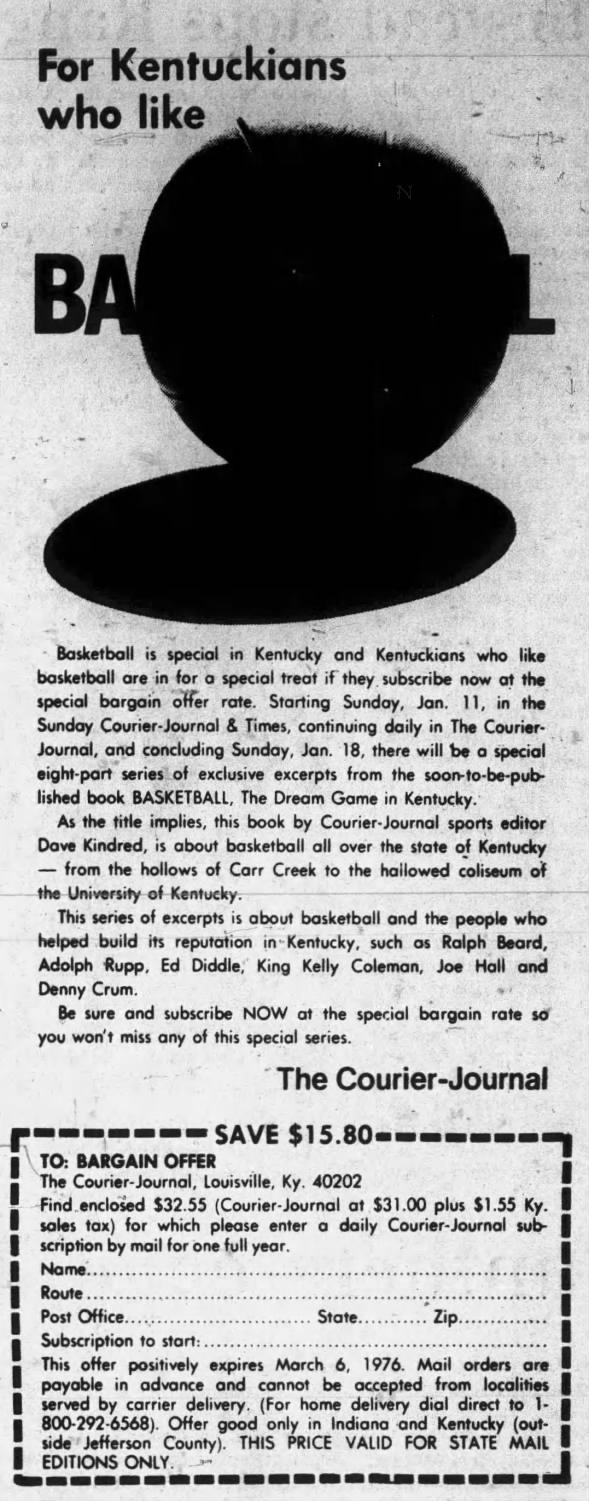
As previously reported, Dave Kindred has a new book out, and it looks like it might make a fine belated gift for Christmas75 (or Christmas76 for you early shoppers).

29 Dec 1975, Mon News-Democrat and Leader (Russellville, Kentucky) Newspapers.com

Monday, July 18, 2022

Vacation Reading

Here are some suggestions for books to read if you go on vacation this summer.  None of them is what we think of as "literature," but they are all well-written and designed to entertain:

Allen Drury, Advise and Consent (1959):  This novel, which won the Pulitzer Prize, tells a pot-bubbling story about what happens when, at the height of the Cold War, the President nominates a prominent Liberal to be the next Secretary of State.  Even if you don't like politics, you will not be bored.

Ian Fleming, Moonraker (1955):  I've never seen the movie called Moonraker, but I'm pretty sure it has very little to do with this book:  the third James Bond novel features a mysterious millionaire who has volunteered to build an intercontinental missile to defend the United Kingdom from its enemies.  Opens with a great section about Bond trying to help M catch someone cheating at bridge.

Pat Conroy, The Prince of Tides (1986):  One of the last -- and most entertaining -- examples of old-fashioned Southern gothic storytelling about a dysfunctional family.

Roger Angell, Five Seasons (1977):  I think this is the best of the various books collecting Roger Angell's columns on baseball for the New Yorker.  The five seasons run from 1972 to 1976 -- three seasons for the A's, and two for the Reds.  It was a great time for baseball, and Angell reacted with excitement and enthusiasm that made his writing even better.

Anthony Trollope, Framley Parsonage (1861):  There are some people who love long and complicated stories about romance among British people in the 19th Century.  If you are one of those people, and you've already read Jane Austen, and Vanity Fair, then it's really time for you to try Anthony Trollope.  He wrote dozens of books, most of which were meant to serve as the equivalents of binge-watching today.  This one was one of his most popular, and it is one of his best.  It's better than re-watching Bridgerton or Downton Abbey one more time.

Wednesday, April 7, 2021

I'm Reading a Book

It's When Cuba Conquered Kentucky by Marianne Walker.

Somewhere back in the comments archives of the HP--oh, how I wish those were still searchable on Google--I wrote about discovering this 1999 book while listening to the late, great Joe B & Denny Show. It was during a state basketball tournament, and they had on the author. Marianne Walker was a professor of English and philosophy at Henderson Community College, and I'm pretty certain this was her second book--after a book about the author of Gone With the Wind and Margaret Mitchell's husband. She had also written for The Courier-Journal's old Sunday magazine, but she was never a sports writer. I remember that she seemed a little uneasy about coming on the radio show with the coaches but then increasingly delighted as the program went on and it became clear that the hosts had absolutely devoured and loved the book, asking her detailed questions about deep-cut passages from it.

A friend got Marianne Walker interested in the story of Graves County's Cuba Cubs, the 1952 Kentucky boys' basketball champion, and it turned into a magazine story and then this book (and, since then, another book still, as well as one about Joe B). She's retired from teaching. Her husband is or was an attorney. My wife and I last night creepily looked up their house on Google Maps. It's a big place on the Ohio River in Henderson. It looks beautiful. I hope they are very happy, and I'll bet they are. She sounds like a happy person in her writing. It's hard for people to fake that when they're good writers.

Marianne Walker is a great writer.

She starts When Cuba Conquered Kentucky (brilliantly) at the Phoenix Hotel in Lexington after the Cubs had lost the 1951 state final to Clark County. The boys are back up in their rooms on the sixth floor:

Raymon, who had been brooding, stopped eating the peanuts he had been snacking on, brushed the crumbs off his shirt, and reared back in his tilted chair with his thick legs spread apart. With arms folded across his chest, he looked up and made rude comment about Joe Buddy's "forgetfulness." The two of them began swapping some rank insults until Doodle, stretched out on his back in his underwear, with one arm lying over his eyes, shouted, "Shut up! Damnit, y'all sound like a couple of plucked hens." He rolled over in the bed, swung his long hairy legs over the side, sat up, and yawned.

Then, leaning forward, he rummaged in the back pocket of his trousers that were lying across the chair and drew out a slender book of matches, a cloth pouch of Bull Durham, and a small packet of thin white paper. Carefully, he tore off a sheet, laid it in the palm of one hand, and gently tapped out a neat little row of tobacco. Doodle was an expert at rolling cigarettes, able to fix them so that they looked like store-bought ones. As the others were waiting for Doodle to say something else, he neatly rolled the paper around the tobacco, moistened the edge of the paper with his tongue, and with a flourish, struck a match on the underside of the end table. Inhaling deeply as if he was partaking of something divine, he blew out a cloud of smoke and said "Whew, that's good tobacco!" Then he looked around at each of them and dropped his voice to a whisper, saying, "I think we oughta quit crying about this year and figure on coming back next year and win the danged thing."

Chapter 2 is about the drive back to Graves County--a lunch stop at Horse Cave, the crowd meeting them at the Eggner's Ferry Bridge in Aurora, a transfer to Cadillac convertibles for the last stretch to the courthouse square in Mayfield:

A little west of Horse Cave, at Bowling Green, the motorcade got on Kentucky 80, which led them into Mayfield. As they traveled through each town--Bowling Green, Rockfield, Auburn, Russellville, Elkton, Hopkinsville, Cadiz, Canton, Golden Pond, and Aurora--they were met by another sheriff or constable who would then lead them through the town. Onlookers parked in cars on either side of the narrow main streets started blowing their horns once they spotted the sheriff or the constable leading the green Kaiser. To them, Cuba represented the dreams of all tiny communities across the great state of Kentucky--the Cubs' success was theirs, too. Stretched across plain wooden storefronts were wide paper banners proclaiming, "Welcome, Cuba Cubs!" Adults and children stood on the sidewalks, alongside the roads, or in front of houses, law offices, hardware stores, and other businesses, waving pennants and flags and yelling, "Yea! Cuba!" Dogs ran barking alongside the Kaiser as the Cubs' long, outstretched arms waved from the car windows. In some town squares, little high school bands played "Sweet Georgia Brown," the Cubs' theme song.

Then, in Chapter 3, Marianne Walker takes us even further back. She opens a telling of Jackson Purchase history, 1818-1951, with a quote from Plutarch: "Men's customs differ; different people honor different practices; but all honor the maintenance of their own peculiar ways." And then she offers a lengthy, concrete discussion of the voting patterns and geographic characteristics that conspired to make the 1950-51 and '51-52 Cuba Cubs an embodiment of the curious relationship of their region to the rest of the state:

Surrounded by rivers on three sides, the Purchase was born in 1818, when Kentucky was already twenty-five years old. For a hundred years the state went on about its business as if the new section had not even been added to it. Until the late 1930s the political powers in Frankfort largely ignored the region because finding anything other than a registered Democrat in the Purchase was like finding hair on a frog's head. ... 

Until the late 1930s and early 1940s, the state politicians, for the most part, directed no funds toward building roads, schools, bridges, or state office buildings in the Purchase, nor did they set up the multitude of semi local agencies that are part of a state government. For example, Graves County in the late 1940s was given an agricultural extension agency but no laboratories or facilities. However, the agency in nearby Hopkins County, which is in western Kentucky but not in the Purchase, had a first-class operation. Just as it is today, politicians preferred spending state and federal money in those counties having balanced party systems. Politically speaking, you can say that the Purchase disadvantaged itself by adhering so strictly to its Democratic stand.

Until 1905, there were no bridges built over any of the three rivers that hem in the Purchase--the Ohio River on the north, the Mississippi River on the west and the Tennessee River on the east--and ferries were too inconvenient or expensive for most of the people in the region to use, Marianne Walker writes. The Purchase was cut off from the rest of Kentucky and any other land (except Tennessee to its south) until a locomotive bridge over the Tennessee River at Gilbertsville came along in 1905. The first bridge for automobile travel over any of the three rivers came in 1929, when the Irvin S. Cobb bridge was completed, linking Paducah with Brookport, Illinois.

For the most part, the Purchase people had no real interest in crossing those rivers. Having been ignored for so long by the state's political powers, they felt no real attachment to Kentucky, even after the state began to show them some attention. Their kinship was with Tennessee. Even after the Eggner's Ferry Bridge across the Tennessee River at Aurora was completed in 1933, finally linking the Purchase to the rest of Kentucky, few took advantage of it.

Marianne Walker writes that Coach Jack Story often told stories about Andrew Jackson of Tennessee to teach his young Cubs about toughness. Then there's a bunch of stuff about the Civil War, TVA, Thomas Scopes, Alben Barkley and the tug of industrial jobs in Michigan. I don't know enough about history to know whether Marianne Walker is right, but she certainly convinced me. Feels right. I read almost every word of this chapter twice through aloud last night to my wife. We loved it!

I'm just getting started with Chapter 4, and Marianne Walker is going through what each player and student manager's family did for a living and how they ended up at Cuba. Some of the other chapters are titled "On the Importance of Acting Right," "The Harlem Globetrotters in Cuba" and "A Pilgrimage." I can hardly wait.

Sunday, September 18, 2016

The Freakin' Weekend (1970)

OK, so here's the deal. People (the people, yes!) have been going all Colin Kaepernick/civil disobedient and posting old NFL Films 1970-season-review stuff on YouTube because life is uncertain and because light shouldn't be hidden under bushels. But, of course, it's not like the light clobbers the darkness. The darkness could not overcome it; the score is always like 23-21, and we're forever committing penalties on third down or dropping passes that hit us between the numbers(!)--the very-soon deal is likely that all of this great stuff will be yanked back down from YouTube any moment. So--spoiler alerts--here it is now for us to enjoy while we can. 

NFL70 kicks off today 1970 (Friday, Sept. 18), and you might remember that the Kansas City Chiefs are the defending champions:


"Quarterback Gary Cuozzo was at the Super Bowl, and he remembers," says Pat Summerall. "His entire team remembers." The Vikings will be taking another shot at a championship with Cuozzo at the helm, not Joe Kapp:


Ebony isn't buying Minnesota's plan.


YouTube doesn't have the film on the 1970 Rams' and Lions' seasons, but it does have awesome playlists of the songs purportedly used in the Los Angeles and Detroit NFL Films productions (Dave Volsky, yes!).


It's easy to see why Ebony likes "able, young John Madden" and the Raiders.


The Bengals will be playing this season without their great, young quarterback, Greg Cook, who is still recovering from an arm injury, so it seems we'll have to wait another year for Cincinnati's "golden age of football prominence" to commence.


Frank Gifford wonders "if people will long remember the 1970 New York Giants?" Well, we'll see in this episode (with commercials!) of NFL Action (hooray!) ...


The AP had a story a few weeks ago that the coach of the Eagles, Jerry Williams, says they are hoping for a winning season, so that probably means Philadelphia isn't going to be any good.


Sports Illustrated chose Dick Butkus and the Bears for the cover of its season-preview issue, but they probably aren't going to be any good either.


Street and Smith's went with Joe Namath and the Jets. They were, of course, super just two seasons ago, but, ever since then, the story with the Jets has been whether Namath is going to play--because of possible suspension, because of injury, because of possible retirement, etc.


Tex Maule a few weeks ago in SI had an analysis of the choking Cowboys. Nonetheless, Boys' Life put Calvin Hill on its cover this month 1970.


You might think from this ad in the Boys' Life that Johnny Unitas is a man without a team, but that is not correct. He's back leading the Colts after missing most of the Super Bowl two seasons ago against New York, and we'll have to see how that turns out.


The Dolphins have come a long way since 1966, and now they're looking great!


As previously reported, the plan appears to be coming together pretty happily in Pittsburgh.


As for the rest, here's how they fared in the preseason (which is a bigger deal in NFL70 than it is now) ...


Despite the 5-1 preseason performance, the Redskins are reeling. 


Vince Lombardi's impact on in Washington was really huge. I didn't get this for a long time--until I actually lived in D.C. for a little while, it felt like this mostly inconsequential anecdote of NFL history. This was incorrect. Washington spent years and years being a joke of the league, and then it spent 20 years being one of the absolute best teams in the league, and Lombardi appears to me now to have been the primary catalyst in that change. 


In summer 1969, there was an AP story in the Kentucky New Era that Sam Huff "took a pay cut in snipping his rich business ties with a clothing firm," in order to come back from retirement and have a chance to play again for Lombardi. (I lost that link--sorry, AP.) The story said that Huff's mind was made to return when he saw Lombardi, who was a Giants assistant in Huff's rookie season, 1956, speak about winning determination in a sales movie, Second Effort:


I was in the Martin Luther King branch of the Washington public library this summer and discovered this fantastic, beautiful book (5 Stars, Highly Recommended) from 1974 ...


Here's its chapter about Lombardi's time ...


Actually, my favorite part of the book is a big section in the back with color pictures of the Redskins' facilities.


So, in conclusion, hooray for public libraries, football, TV, all media and affordable, universal access!


Saturday, August 8, 2015

English Soccer Preview: Roy of the Rovers

I have no idea who will win the English Premier League this year -- actually, of course, that's not true:  it will be Chelsea, Manchester United, or Manchester City.  But the point here is that I'm not really in a good position to preview the new soccer season that kicked off today.  (I didn't even realize until today that AFC Bournmouth -- which plays in a tiny stadium that seats only 11,000 people -- have been promoted to the Premier League for the first time in their history).  To be honest, last season was so boring -- Chelsea dominated from beginning to end -- that I didn't pay much attention.  (I also don't watch as much soccer when UK's basketball team is very good.)

But yesterday, I got a copy of Roy of the Rovers:  Best of the 1970's.  In reading British journalism, you will often read that this or that amazing play is "real Roy of the Rovers stuff."  And I got to wondering what they meant.  It turns out that from the late 1950's until 2000, there was a British comic book called "Roy of the Rovers," which told the story of Roy Race, a fabulous soccer player for the (fictional) Melchester Rovers.  This sounded interesting.  So I wanted to see what it was like.

I don't know what the whole series was like -- I just finished reading about the 1976-77 season.  But it was fantastic.  This is what Gil Thorpe should have been but never was -- an entertaining comic series for 10-year-olds who are obsessed with sports.  Here are some of the problems that Roy and his squad faced during the 1976-77 season:

1.  A grocery chain is offering a prize of 30,000 pounds for any player who can score 50 goals in both League and Cup competitions during the season.  A reporter thinks that Roy cares more about winning this big prize than about playing for the team.

2.  The Rovers have a "super-sub" who's great at scoring last-minute goals.  The fans want him to play more often.  But only Roy knows that the "super-sub" is actually out of shape, and can't stand the pace of a full game.

3.  The Rovers lose a game because of a goalkeeper's mistake, and the goalkeeper loses his confidence.  How can Roy -- who is both a player and the manager -- get his goalkeeper's head back in the game?

4.  The Rovers open the year with a long undefeated streak.  How will the lads withstand the pressure as the streak grows and grows?

5.  Roy's wife is pregnant.  How will the pregnancy affect Roy's concentration?

6.  The Rovers are playing a big F.A. Cup game in heavy fog.  How will they overcome the difficult conditions?

Now when I was 10 years old, these were exactly the sorts of story lines I would have found interesting -- there just wasn't enough sports on TV or the radio, and I was always looking for more.  Plus, the folks who did Roy of the Rovers really knew their soccer.  A lot of the fictional stories I read about football and baseball barely got the rules right.  But they get everything right in Roy of the Rovers -- at least as far as I can tell.  The League Cup and F.A. Cup games happen in the season exactly when they are supposed to, the game stories themselves are dramatic but by no means incredible, we get to see the complete lineups when there's a particularly big game, and at one point we even get a glimpse of top of the league standings:

Melchester:  8-0-3 (19 points)
Tynecaster:  7-2-2 (16 points) (goal differential of 16)
Burndean:  6-1-4 (16 points) (goal differential of 12)
Kingsbay:  6-1-4 (16 points) (goal differential of 7)
Portdean:  6-1-3 (15 points)
Carford:  6-3-2 (14 points)

When I was 10 or 11, this sort of thing would have kept me busy for hours -- I would have eventually figured out the names of all the teams, and I would look for old issues so that I could figure out who had won the League in the past.  And my guess is that this is exactly what a lot of British boys did.  (For example, here you can find a loving and detailed Wikipedia article about the Rovers.)

Oh, and during the summer -- since there's no British soccer -- they had to come up with other things for Roy to do.  My book has a story about him coming over to America to help a British friend who plays for an American soccer club.  (Roy even suits up for an American football game!)  Again, I'm so happy that they didn't have the Rovers playing in the summer.

Unfortunately, we didn't have anything like Roy of the Rovers in America -- I had to make up my own imaginary sports leagues, and to be honest the team names I came up with weren't nearly as good as "Melchester Rovers" or "Carford."  But it makes me happy to know that so many British fans my age got to have so much fun.

Thursday, October 16, 2014

Paul

I'm just getting started on What Paul Meant, a 2006 book by Garry Wills. A friend gave it to me after his wedding in 2007, but it took me this long to get past how bothered (small) I was by the title. Anyway, here's some stuff from pages 13, 14 and 15 that I think is just rock-'em/sock-'em great:

... When Paul address the ekklesiai, the "gatherings of Jesus," he is writing to those who met in the homes of particular men or women, in the same town or in several towns. He addresses himself to the whole gathering, in each case, not to some leader or leaders. Some towns had more than one such home-gathering. There was no hierarchy among the gatherings, one having more authority over another. The housekeepers, whether male or female or both, were the informal leaders of the gatherings. Emissaries ... moved from gathering to gathering, normally in teams, often husband-and-wife teams (Rom 16.6-15), like the team of Peter and his wife, or of the Lord's brothers and their wives (1 Cor 9.5). Paul usually had several partners in his team--most of his letters are written with cosenders, and he often refers to coworkers, women as well as men.

New gatherings were hived off from pre-existing ones, sometimes by the work of emissaries like Paul's team, sometimes by the gathering's own natural reach outward toward friends or relatives or associates, either in the same town or in other ones. The proliferation of these gatherings was astonishingly rapid. They had grown out from Palestine even before Paul came to believe in Jesus. They were already present in the country where he was living (Syria). He began his work as a junior partner (with Barnabas) in an emissary team operating from a pre-existing gathering at Antioch. The story of Paul is never that of an individual, some religious genius hatching his own religion out of his own head. We find in his letters hymns that communities had formed and sung before he set them down in an epistle. He constantly appeals to traditions handed on to him, to be handed on to others. It is as a testimony to the vital explosion of belief in Jesus all across the Diaspora that Paul assumes his importance.

He takes us closer in time to Jesus than does any other person or group or body of writings. The best way to find out what Jesus meant to his early followers is to see what Paul meant to his fellow believers, many of whom had seen Jesus in his earthly lifetime or after his Resurrection, without having written their stories down for us. Paul did write. But he was writing about a shared experience, not a single and idiosyncratic one. If Paul was such a foe and underminer of Jesus, why was he accepted so soon and broadly by those who knew Jesus? The answer is that Paul was not a counterforce to Jesus but one of the early believers who together bore witness to him. The Jesus gatherings in the Diaspora proved more fertile and lasting than those in Judaea itself, not because of any one man's brilliance, energy, or deceptions, but because they were more vitally expressive of what Jesus meant. Paul was part of this explosion of belief. His letters are dispatches from that hurricane of activity.

Tuesday, August 26, 2014

Run to Daylight! by Vince Lombardi with W.C. Heinz (1963)

On October 14, 1961, at the 46th Street Theater in New York, a new play opened with the unlikely title of How to Succeed in Business without Really Trying.  It was a massive hit, winning seven Tony Awards, taking the Pulitzer Prize for Drama, and running for 1,417 performances.  It was, among other things, a hilarious spoof of the massive, all-conquering American corporation of the 1950's.  The massive government expenditures of the 1940's and 1950's, along with a booming U.S. economy, had left the American landscape scattered with enormous companies.  In such a huge corporation, it was easy for people to rise -- or fall -- for reasons that had little to do with their own merits.  How to Succeed tells the story of how the ambitious J. Pierpont Finch goes from window-washing to the Boardroom through clever personal tricks (and lots of brown-nosing).  The Apartment (opened on June 15, 1960), explores a similar milieu, as we follow the adventures of Jack Lemmon in a gigantic insurance company where the executives spend more time managing their love lives than their careers.

But movies and Broadway shows take awhile to come together, and are sometimes a few years behind the zeitgeist.  (For example, How to Succeed was based on a book that was published in 1952.)  Rod Serling, a very keen cultural observer, often focused The Twilight Zone (another product of the early 1960's) on white collar executives -- but he found their lives to be highly stressful, and the executives themselves to be the victims of ruthless, never-ending competition.  We can also see this model in The Andy Griffith Show, which presented Big-City life outside of Mayberry as one of constant push and drive.  And these shows were not wrong.  The stuffed, bloated corporation of the 1950's was a dinosaur, too big and too inefficient to compete in the New World that was emerging from the post-war era.  By the 1970's the old U.S. corporation would be changing rapidly, and the ruthless J.R. Ewing would be pop culture's new face of American business success.

NFL fans, however, didn't have to wait for J.R. Ewing to see the future of the white collar world.  In the fall of 1962, W.C. Heinz traveled to Green Bay to collaborate with Vince Lombardi on a football book.  The 49-year-old Lombardi was on top of the world in 1962 -- he had just won the 1961 NFL championship, the first of five titles he would win at Green Bay.  The 1962 Packers were one of the greatest teams in the history of the NFL.  They went 13-1, and they outscored their opponents by the remarkable total of 415-148.  The Packers had five Hall of Famers on defense alone:  Willie Davis, Henry Jordan, Ray Nitschke, Herb Adderley, and Willie Wood.  The offense was also loaded, with Bart Starr, Paul Hornung, Jim Taylor, and Boyd Dowler among others.  Any football fan should be happy to have such a detailed look at such a great team.

But there's a lot more to Run to Daylight! than a discussion of football.  Lombardi's success was based on a determination to simply work much harder than almost everyone else in the NFL -- and he certainly wasn't going to interrupt his efforts at winning the 1962 championship to spend much time on a book.  After a few interviews that didn't go very well, Heinz grew concerned about how to put the book together.  He eventually had a brilliant idea -- focus on a single week, collect as many stories as he could from other sources (including Lombardi's wife Marie), and then write the book as a journal of one week in the mind of Vince Lombardi.  The book -- done entirely in Lombardi's voice -- starts on the Monday before the fourth game of the season, a big showdown between the undefeated Packers and the undefeated Lions.  We follow Lombardi through the whole week -- film sessions, game planning, meetings with the team, filming his TV show, practice drills, even a quick game of golf on Saturday afternoon (he doesn't play well because he's distracted by thoughts of the Lions) -- and then in the last chapter, we are with him on game day.

Heinz was lucky that Lombardi was such a fascinating character, that the Packers were such a great team, and that the game he chose was a nail-biter (the Packers won 9-7 thanks to an interception by Adderley with less than two minutes remaining.)  But because Heinz was such a skilled writer, and because he observed Lombardi so closely, we can actually see the beginnings of a new version of American capitalism.  From the first pages, when Lombardi is worrying about the Lions on his way to the office on Monday morning, we are part of a world that feels incredibly modern to anyone in a white collar job in 21st-century America.  At the center of the book is Lombardi -- the boss that Michael Scott always wanted to be -- passionate about doing his best, driven to succeed, a transcendent leader of men, someone who knows almost instinctively how hard to push everyone around him.  And he never, ever stops pushing.  We sense his frustration when the game film shows up late, or when the Packers' field is damaged by a high school game, or when players miss their assignments.  We see his assistant coaches working around the clock -- even flying off to college games on Saturday to scout for next year's draft.  We see the press kept at a safe, and respectful, distance so that Lombardi and his team can focus -- focus -- FOCUS -- on the task at hand.  This is no 9-to-5 world with Union rules and coffee breaks.  Working for the Packers means that the job always -- ALWAYS -- comes first, no matter how often you win, no matter how famous you become, or how much money you make.  The whole mindset that runs throughout the book -- from beginning to end -- is one of excellence pursued for its own sake.

These days, of course, that mindset completely dominates the NFL -- every fan simply assumes that his team is constantly working for victory.  But that attitude isn't limited to pro football -- it is now common throughout the U.S. economy.  Every time you get an assignment on the weekend, every time you check your e-mail at home, every time you work late because you have to get that contract, complete that proposal, finalize that draft memo -- you are in Vince Lombardi's world.  Lombardi presented the good ole boys of the NFL with a simple challenge:  What if I just work all the time?  What if I never ease up, never slow down, never stop?  What if I put the job ahead of my personal life, and my own comfort, and my friendships, and even my loyalty to my players?  What if no level of success is ever enough?  What could happen then?  And as the economy changed, and the world changed, more and more executives found themselves asking those same questions -- or being asked them by new, and more demanding, taskmasters.  (It is no coincidence that Lombardi was in great demand as a motivational speaker by businesses across the country.)

Lombardi succeeded, and his imitators in the business world have also done very well.  There are no more companies like the World Wide Wicket Company from How to Succeed.  Everything today is measured, efficient, with all company assets expected to deliver a healthy rate of return each year.  It's a big change from comfortable suburban future most Americans expected in the early 1960's.  But for all the ink that has been spilled on this topic, few writers have captured it better than W.C. Heinz.

Highly recommended for football fans, and recommended for anyone interested in the social history of America.

Wednesday, February 26, 2014

The Lizzie Bennet Diaries

About a month ago, Number 1 Son told me about something that sounded almost like a parody of modern culture:  somewhere on the Internet, a group of people had done a modern version of Pride and Prejudice.  They took the characters and plot from Jane Austen's classic novel, updated them to our time, and told their story in a series of short videos, tweets on Twitter, and other Internet posts.  The whole idea seemed very odd, but Number 1 Son claimed it was good, and he normally knows what he's talking about.  So one night just before bed, I decided to see if it was any good.  At 2 A.M., I was still watching and I had been convinced.

You can see the whole thing here.  The basic set-up is that Lizzie Bennet is a 24-year-old American grad student with two sisters.  Jane (her older sister), is sweet and kind, while Lydia (her younger sister) is . . . well, let us say, more outgoing.  All three of the sisters -- but especially Jane and Lizzie -- are coming under pressure from their mother to find rich husbands.  Lizzie isn't that interested in finding a husband, but she decides to keep a video blog about her life as part of her graduate work in communications.  Twice a week, she posts short videos telling us about the latest events in her family's life.  And so we learn about how Bing Lee (a wealthy med student) has bought the house next door, and about his friend Mr. Darcy (who appears to be a big snob).

Each video is only about 3 to 5 minutes long, but that turns out to be a great length, because each video is basically a short scene in a much larger story.  At first the videos all take place in Lizzie's room at home, but as the story progresses, we follow her to other locations, each of which ties back to something in the original novel.  If you want, you can follow the story by merely watching Lizzie's diaries (100 in all), or you can also follow the tweets and videos from the other characters.  Lydia, for example, has 29 videos of her own, which she tends to make when Lizzie's not around.

I thoroughly enjoyed the whole project.  And I was not alone.  Each of the videos has hundreds of thousands of views on YouTube, and the whole project won an Emmy Award.  Last year, the London Guardian picked The Lizzie Bennet Diaries as the best small-screen adaptation ever made of any Jane Austen novel -- even ahead of the legendary BBC production with Colin Firth.

Much of the credit for the success of the Lizzie Bennet Diaries must go to the actors, who have to perform within the tiny confines of a video blog.  Every time we see them, they are simply sitting in front of the camera.  But they do a remarkable job of projecting real personalities nonetheless.  Special credit should be given to Ashley Clements, who must carry the whole project as Lizzie.  She is onscreen almost the whole time, and must win the affections of the audience to keep people watching.  She also has to portray all of the countless emotions experienced by Lizzie over the course of the story.  Mary Kate Wiles, who plays Lydia, also deserves special praise for giving depth to a character who is often portrayed merely for laughs.  And Daniel Vincent Gordh must get credit for portraying Mr. Darcy in a way that was both consistent with all the bad things we had heard about Darcy and also likeable enough to make the audience root for him.

But most of the credit should go to Bernie Su, the Head Writer and Director.  He does a masterful job, not only of getting excellent performances from his young actors, but by turning out hour after hour of snappy dialogue.  He also had to work out all the issues presented by modernizing one of the most popular stories of all time.  As you follow the story, you realize just how many difficult decisions go into something like this.  How do you get Lizzie's parents to appear in her video diary?  (You don't; Lizzie imitates them for the camera.)  How do you find room for all five daughters from the original story?  (You cut it down to three daughters and then develop clever ways to bring Kitty Bennett and Mary Bennett -- the other two daughters from the novel -- into the story).  In the novel, Elizabeth Bennett receives a proposal from a Mr. Collins -- a tiresome Anglican priest.  What's the modern equivalent of that?  (That would be spoiling).  The choices go on and on, and if you love the novel I think you will be impressed with the thought and care that went into each of them.  If you don't love the novel -- or don't know anything about it -- you can still enjoy the story.  (Some of the folks commenting on YouTube didn't know The Lizzie Bennet Diaries was based on a book.)

I'm sure there will be people who believe that Jane Austen's masterpiece shouldn't be turned into a video blog, but personally my respect for her genius was increased.  As a guy, I tended to see the story more from the perspective of Darcy or Mr. Bennett, and I never fully appreciated the many tortures suffered by Elizabeth.  But in this version -- where we see everything from her perspective -- I can now better understand just how embarrassing and awkward she finds her situation.  At the same time, without Colin Firth's dramatic presence to distract us at the beginning of the story, one can see that Jane Austen has perfectly captured the behavior of the nervous guy with a crush:  Darcy constantly hangs around Elizabeth, and regularly drops vague remarks that are designed to draw her out, but he won't declare his feelings until he can't help himself.  This is exactly how a certain type of guy behaves when he runs into the woman of his dreams, and most girls (like Elizabeth Bennett) find it very confusing.  I give Jane Austen a lot of credit for figuring it out.

The success of The Lizzie Bennet Diaries has led to imitators.  Someone is doing an adaptation of Jane Eyre, which you can see here.  And Bernie Su is now working on a version of Emma.  I am very happy to see the classic novels of the 19th century getting a new lease on life in this manner.  (Vanity Fair, anyone?)  But it will be very difficult for anyone to do this sort of thing as well as it was done in The Lizzie Bennet Diaries.

Wednesday, August 7, 2013

Book Review: The Cuckoo's Calling, by Robert Galbraith (2013)

As everyone knows by now, "Robert Galbraith" is a pseudonym for J.K. Rowling, the creator of the Harry Potter books and, in my opinion, the most successful artist of my generation.  While I am a great admirer of Rowling's, her last book, The Casual Vacancy, had no interest for me.  It was a novel about gossip and ambition in the suburbs, and after reading Rowling's descriptions of the Dursleys for so many years, I had no confidence that she could capture the discreet charm of the bourgeoisie.  Rowling has many gifts, but sympathy for middle-class strivers is not among them.  She is, as far as I can tell, what we Americans refer to as a "snob," and what English people often refer to as a "Tory."  She finds it very difficult to root for -- or even understand -- middle-class people trying to do the best they can with limited gifts.  So I don't think doing a novel about the suburbs was the best use of her unique talents.

On the other hand, as soon as I heard she had written a novel about a private eye, I got excited.  The private eye genre was invented during the last Robber Baron era -- it was a way for guys like Dashiell Hammett and Raymond Chandler to write about men of character in the age of Babbitt.  The private eye stands apart from the capitalists, the government stooges who work for the capitalists, and the criminals who are the enemy of both groups.  The private eye follows his own path, which leaves him free to do the Right Thing, no matter how painful that may be to bourgeois sensitivities.  So it was a perfect genre for someone like Rowling -- who admires honor and self-sacrifice, but who has little patience with job-seeking or rules.

Rowling has another quality that made the private-eye genre a good choice for her.  She majored in Classics, and at its best, the Ancient World was all about form -- you get the form right, and any other good qualities you like will follow.  In this book, for example, Rowling is very careful to check off all of the classical requirements of a private eye story.  Her hero, Cormoran Strike, is an eccentric loner -- separated from his beautiful girlfriend, forced to wear a prosthetic leg because of a wartime injury, a guy with no money, no significant business prospects, and few friends -- but a firm sense of Duty and Honor.  As the story begins, he gets a perky and talented secretary -- Robin Ellacott, a 25-year-old version of Hermione who is engaged to a very nice and proper young man, but who really wants to be a detective.  Throw in a mysterious (and very lovely) dead girl, a bunch of eccentric rich people, and a skeptical police force, and you basically have all the elements of your classic private eye story.

And those old guys in the Ancient World knew what they were about -- because in this case, the form really helps the story along.  Hammett, Chandler, and countless others have told private eye stories for a reason -- no matter how banal capitalist culture may appear, we humans never lose our desire to watch a man of principle trying to do the right thing.  From the moment we meet Strike and Robin, we want them to succeed -- to overcome the many obstacles in both the case and their personal lives, and to find out what happened to Lula Landry, a 23-year-old model who apparently killed herself by jumping out a window three months previously.  Rowling is exceptionally good at both male characters and at male-female friendships, and she does a splendid job with Strike and Robin -- they are kindred spirits, but Rowling never pushes the relationship between a middle-aged private investigator and a young secretary who just met each other beyond the bounds of reason.

Rowling has also retained her ability to make her plots run along smoothly.  Almost no writers of my generation appreciate how a well-turned plot -- each event carefully thought out, each scene setting up the next in a logical and compelling manner -- makes any story better.  But Rowling does.  From beginning to end, you are confident that you are in the hands of a master craftsman who knows how to answer one of the most basic of all human requests:  "Tell me a story."

So hurrah for J.K. Rowling, and hurrah for Cormoran Strike.  I'm already looking forward to the next book in the series.

Monday, June 24, 2013

Thought for Monday Afternoon

I've been re-reading The Name of the Rose, the wonderful Italian novel about medieval theology by Umberto Eco, in the elegant translation by William Weaver.  I came across the following sentence, which has brightened this Monday for me:

The older I grow and more I abandon myself to God's will, the less I value intelligence that wants to know and will that wants to do; and as the only element of salvation I recognize faith, which can wait patiently, without asking too many questions.

Umberto Eco, The Name of the Rose (1980) at 442 (Everyman's Library edition).

Sunday, June 16, 2013

HP SPECIAL REPORT: The 1942 Heath High School Yearbook Is Online

This just in to the Kentucky desk, who is so excited that it keeps having to go back and correct typos as its fingers trip over one another trying to type this sentence ... the very, very awesome West Kentucky Genealogy Facebook outfit has posted 34 photographs of the 1942 Heath High School yearbook! I hope the--seriously, it's very, very awesome--West Kentucky Genealogy Facebook folk don't mind if we include one here:


The yearbook, which at some point became known as the Pirata, was then known as Heath Review. More in the comments as this rapidly coalescing story warrants ...

Thursday, May 30, 2013

Book Review: The Amazing Spider-Man Volume 4 (Marvel Masterworks)

Since 2002, there have four different movies about Spider-Man, and each of them grossed over $750 million worldwide.  In 2011, there was even a Broadway show about Spider-Man -- with music and lyrics by Bono and the Edge.  The epic saga of Peter Parker, Uncle Ben, Aunt May, and the various girlfriends and villains that Parker meets as Spider-Man has become one of the great American legends -- a story known to almost everyone with even the faintest interest in pop culture.

At the other end of the cultural spectrum, all the smart folks these days are watching high-end TV shows like House of Cards or Mad Men -- shows with limited runs of 10 to 13 episodes at a time.  Each episode tells its own stories, but larger arcs run through the season as well.  David Chase brought this formula to HBO with The Sopranos and it has now become the dominant form at the critically-acclaimed end of TV watching.  Since 2007, the Emmy Award-winners for Best Drama have been The Sopranos (2007), Mad Men (2008, 2009, 2010, and 2011), and Homeland (2012) -- all shows that aired on cable and that fit this pattern.

Now here's the thing -- Spider-Man isn't that far removed from The Sopranos.  In fact, if you go back to the original comics of the 1960's that made Spider-Man famous, you'll see that while each issue (usually) stands on its own, every episode also contributes to the longer arcs that run through the whole story -- just like your typical high-end TV show.

But come on, you say.  Spider-Man doesn't have the depth or characterization that you would find in an Emmy Award-winning TV show.  There's some truth to that.  These stories were designed to be enjoyed by intelligent 10-year-olds, and there are large aspects of the human experience that they don't address.  But on the other hand, you shouldn't under-estimate how well these characters are drawn, or the passion that they can inspire.  I doubt very much that people will be making movies about Tony Soprano in 40 years.

And the more you start paying attention to comic books -- which is inevitable if you live in a house with three intelligent boys -- the more you realize how large Spider-Man bulks in the culture.  It's not just the hit movies.  It's a whole concept of heroism that is very different from the strong, silent types who dominated American culture in the age of Gary Cooper and Jimmy Stewart.  Peter Parker is a nerd.  He talks all the time.  He gets nervous around girls.  He worries about his aunt.  He worries about money.  He loses his temper when kids make fun of him.  He makes really funny jokes (mostly to himself).  Some times -- a lot of times -- he is petty and small-minded.  But in the end, he is honorable and brave, and willing to risk his life for others.  In short, Peter Parker resolves the tension between the tough guys who fought World War II and the Beatniks who felt alienated from mainstream culture in the late 1950's and early 1960's -- he combines the strength and decency of the first group with the ironic distance of the second.  No wonder he is so popular in a society that wants desperately to do the right thing -- but isn't quite sure what that is.

Spider-Man was developed in the early 1960's by Stan Lee, who was -- at the time -- a 40-something genius in the middle of re-inventing comic books altogether.  Lee took a genre that had almost died out in the 1950's and revived it, creating characters like the Fantastic Four, the Hulk, Iron Man, and Spider-Man.  But more than that, Lee really thought about how annoying it would be to live as a super-hero in our world, and so he developed the type of conflict-ridden characters so popular today.  But none of those characters was as well-done as Spider-Man, who burst onto the scene in 1962 and quickly established himself as Lee's greatest creation.

By late 1965, Lee and the rest of the team at Marvel Comics were on an incredible roll.  Month after month, they rolled out new characters and stories who remain part of American folk-lore.  And so if you get The Amazing Spider-Man Volume 4 -- which includes ten issues from December 1965 to September 1966 -- you are in for a treat.  The volume works almost exactly like a modern hit on cable television.  It starts with a three-part epic in which Peter Parker starts going to college, meets future love interest Gwen Stacy, worries that his Aunt is going to die, and is almost killed by one of greatest enemies -- Doctor Octopus.  Peter Parker's trevails continue through the middle episodes, as he fights lesser villains, while a larger force is steadily moving against him.  And then in the last two issues, he is captured by his other great enemy -- the Green Goblin -- who not only defeats Spider-Man, but actually uncovers his secret identity.  That sets up a slam-bang finish to the volume that's better than almost anything you'll find in a movie theater this summer.

Some people don't like any comic books, and that's fine.  But I think you should look for quality wherever you can find it, and in my opinion, Spider-Man at his peak was about as good as pop culture gets.  If Stan Lee were in his 40's today, he'd probably develop a show for HBO or AMC that would win lots and lots of awards.  His imagination and writing is that good.  But in 1966, everything was a lot more rigid than it is now -- and so all of this energy was channeled into comic books that sold for 12 cents apiece, and that were never read by anyone over the age of 20.  We can only be happy that those kids loved what they read so much that they kept it alive, and that kids today can have the same fun of wondering just, how, exactly, Spider-Man will escape this time.

Sunday, May 5, 2013

NBA (and ABA) Playoffs, Round of Eight

So, when we left off last season, 1966-67, the Boston Celtics' long run of NBA championships had been at last ended at eight, as the Philadelphia 76ers put together what even Bill Russell had to agree was one of the best seasons in NBA history. 


As the 1967-68 NBA division semifinals commence, all indications are that the 76ers are ready to begin a championship run of their own. Philadelphia finished the NBA's first 82-game regular season with 62 wins--including a 30-point romp in the season's last week against the Western Division-runnerup Los Angeles Lakers. The 76ers' 31-year-old, hometown-hero center, Wilt Chamberlain, had 53 points, 32 rebounds and 14 assists in the game, en route to his fourth-straight honor as the league's most valuable player. Like last season, Chamberlain was expected to shoulder less of the team's scoring load. After his first nine NBA seasons, in which he averaged no fewer than 30.1 points per game, Chamberlain had averaged 24.1 and 24.3 points in the 1966-67 and '67-68 seasons, respectively. In 1967-68, he also averaged a league-best 23.8 rebounds and totaled a league-best 702 assists (8.6 per).

Also qualifying from the playoffs from the Eastern Division are the Boston Celtics (54-28), New York Knichs (43-39) and Detroit Pistons (40-42). The Cincinnati Royals (39-43) and Baltimore Bulllets (36-46) finished out of the reason.

In the Western Division, the final standings saw the St. Louis Hawks (56-26) in first, followed by Los Angeles (52-30), the San Francisco Warriors (43-39), the Chicago Bulls (29-53), the expansion Seattle SuperSonics (23-59) and the expansion San Diego Rockets (15-67). After winning the Western Division last season, San Francisco slid in the standings in 1967-68 without Rick Barry, the NBA's rookie of the year in 1965-66 and leading scorer in 1966-67.

Barry left San Francisco and the NBA to join the Oakland Oaks of the first-year American Basketball Association. However, a San Francisco judge ruled in favor of the Warriors in a court case that prevented Barry from playing for the ABA Oaks for one year under terms of the NBA's reserve clause. So, with 23-year-old Barry providing radio commentary, the Oaks went 22-56 in the first ABA regular season--last place in the Western Division, behind the New Orleans Buccaneers (48-30), Dallas Chaparrals (46-32), Denver Rockets (45-33), Houston Mavericks (29-49) and Anaheim Amigos (25-53). In the Eastern Division, it was the Pittsburgh Pipers (54-24) coming in first, ahead of the Minnesota Muskies (50-28), Indiana Pacers (38-40), Kentucky Colonels (36-42) and New Jersey Americans (36-42).

The NBA playoffs open Friday, March 22, 1968. Here are the round-of-eight pairings:

-- 76ers vs. Knicks,
-- Celtics vs. Pistons,
-- Hawks vs. Warriors and
-- Lakers vs. Bulls.

The ABA playoffs tip off Saturday, March 23, 1968. Here are those round-of-eight pairings:

-- Pipers vs. Pacers,
-- Muskies vs. Colonels,
-- Buccaneers vs. Rockets and
-- Chaparrals vs. Mavericks.

Thursday, April 11, 2013

The Bronze Horseman and Other Poems by D.M. Thomas

Poetry translations are very difficult especially from a language so different from English as Russian. When D.M. Thomas set out to translate works from Alexander Pushkin he put aside the idea of rhyme and meter (for the most part) and focused fully on meaning and emotion. I have always found his translations to be my favorites as I find he captures the essence of the poems so well and for years I have been looking for a copy of his wonderful book. Yesterday to my surprise I found a copy in the used section of our locally owned bookstore and snatched it up with great pleasure. Here is a short poem from the collection and thank you to D.M. Thomas.

Confession

I love you - though it enrages me,
Though it is toil and pointless shame;
This hopeless stupidity
I pour out at your feet!
It doesn't become me and I'm too old! . . .
It's high time I was sensible!
Yet I recognize all the symptoms
Of the illness in my soul:
Without you I am bored - I yawn;
With you I am sad - I endure it:
The unendurable! What I'm saying,
My angel, is . . . I love you!
When I hear, coming from the drawing-room,
Your light step, or the rustle of
Your dress, or your innocent girlish voice,
Suddenly I'm like a simpleton.
You smile - it is joy;
Your turn away - it is grief;
For a whole day of torment
Your pale hand is a recompense.
When, diligently yet nonchalantly,
You sit over your embroidery-frame,
Your eyes lowered, your locks swinging,
I gaze at you, content to be quiet,
Tenderly, like a child! . . .
Should I tell you of my unhappiness,
My jealous sorrow, when,
Sometimes even in bad weather,
You set out for a long walk - alone?
And the tears you shed in solitude,
And our talks in the corner,
And the journeys to Opochka,
And the piano in the evening? . . .
Alina! Have pity on me.
Perhaps, because of my sins,
I am not worthy of your love.
But pretend! Your glance can express
Everything so wonderfully!
Ah, it's not difficult to deceive me!
I want to be deceived!


Pushkin wrote this poem in 1826 when he was around 27 years old.   It's a wonderful example of his love poems.

Of all the great masters in literature Pushkin is perhaps the least studied in the United States.  I'm not sure how they view him in Europe.  Pushkin, though he died very young, did enough to make himself the Shakespeare of Russian literature.  It's hard in some ways for us to imagine but when he was beginning to write there was in essence no Russian literature.  It simply didn't exist.  By the time he died at age 37 he had created the basis of what would become Russian literature.  What he did in such a short amount of time and at such a young age, similar to Shakespeare, is simply stunning. 

This particular collection of his work has a collection of short poems as well as a collection of narrative poems and dramas.  For instance if you've ever seen the movie Amadeus you may enjoy the short play Mozart and Salieri on which the movie is based. If you'll recall the movie you'll enjoy how the play begins.

Salieri:
Men say there is no justice on earth;
I say there's none in heaven either.
. . . I was happy:
In peace I enjoyed my toil, success,
And fame, as well as the toil and
Successes of my friends and comrades
In this woundrous art.  Never did I
Know envy - oh, never - neither when
Piccini captivated the ears
Of the philistine Parisians,
Nor when I heard for the first time
The opening chords of Iphigenia.
Who will say the proud Salieri
Was a contemptible envier,
A serpent trampled on by men, yet,
Still alive, impotently gnawing
Sand and dust?  But now - I will say it
To myself - I am envious.  I
Envy.  O heaven!  where is justice,
When the sacred gift, when immortal
Genius, is sent not to reward
Self-sacrifice, burning love, toil,
Ardour, supplications, but illumines
The head of a madcap, an idle rake?
O Mozart, Mozart!


I'm sure there have been dissertations written on the topic, but I've always wondered if Pushkin saw himself in the version of Mozart he created.  Pushkin was a genius but he also was a bit of a buffoon it seems.  He had many love affairs, spoke out when he should have stayed silent, and died fighting in a duel over a woman who didn't seem to really love him.  Perhaps he saw both Salieri and Mozart in himself.  Two sides of his own personality the more disciplined self hating the genius that seemed to create new art that would inspire generations seemingly without effort.

What I do know is that Pushkin should be one of the most prominent figures studied in literature in the United States, but he is not and that is a shame.  If you ever stumble upon a copy of this book for $3 as I did, snatch it up because it is a real treasure.